

 AU & NZ
 SG
SG
 MY
MY
 US
US
 IE
IE

The Curriculum Reboot Report
To understand the real-world impact of the current curriculum, our report used data from the Department for Education and analysed five years of GCSE entry trends, tracking students from Year 9 through to Year 13, which marks their final opportunity to secure a passing grade.
By focusing on core pillars like Maths, English, Science, Computing, and Modern Languages, we’ve identified widening gaps in uptake and attainment. To expand this, we’ve cross-referenced these with A-Level entries to reveal where student interest thrives or declines post-16. This allowed us to see the alignment, or disconnect, with specialist skills and vacancies waiting for students in the future workforce.
A-Level Pipeline Pressure
To understand how subject choices made at school translate into real-world opportunities, the report introduces a ‘Representative Pipeline Pressure’ metric.
Pipeline pressure: The percentage of a single A-Level cohort that would be required to fill a representative sample of job vacancies associated with that subject.
By comparing the total national output of Year 13 students against current market demand, we can see the minimum 'capture rate' required to sustain these sectors. Rather than treating students as job-ready candidates, A-Level entrants are viewed as the upstream pipeline from which future graduates, professionals, and specialists are developed.
The roles analysed are illustrative rather than exhaustive, offering a conservative indication of demand at the top end of the labour market.
A National Perspective
In the 2025 academic year, student participation in GCSEs reached record highs in more specialised subjects, with key findings highlighting:
- Spanish GCSE saw the largest growth, surging 20% from 109,655 entries in 2021 to 131,985 in 2025.
- Computing followed with a 16% increase from 2021, while English Literature and Maths both saw a 13% increase in entries from 2021.
- Driven largely by the rapid advancements in AI and the tech sector, there is also a growing ambition among students taking Computing at A-Level, with entries surging from nearly 13,000 in 2021 to almost 20,000 in 2025.
However, a concerning trend has emerged. By the 2025 exam period, nearly 218,000 students in England were still working toward a passing grade in at least one GCSE subject after Year 11. The highest volume of these ‘retake’ attempts was in the core subjects of Science, Maths, and English Literature.
This represents a 16% rise since 2024 and a staggering 33% increase over the last two years, suggesting that more students are struggling to secure the basic qualifications needed to thrive in the workforce.
Qualification Gap Across the Subjects
Analysis of subject trends reveals consistent popularity in specific areas at both GCSE and A-Level, while also highlighting the performance of core subjects essential for employment and how the current job market still demands specific GCSE qualifications.
English
English Literature and Language combined remain cornerstones of the current curriculum, with GCSE entries surging by 72% over the last decade. Participation grew from roughly 830,000 in 2016 to 1,440,740 by the 2025 season.
However, of the 1.4 million students in 2024, only 6,605 – roughly 0.5% – progressed to the combined English A-Level in 2025. This highlights that while English is a “must-have” foundational qualification, the combined A-Level has become a niche path chosen by a small, dedicated group.
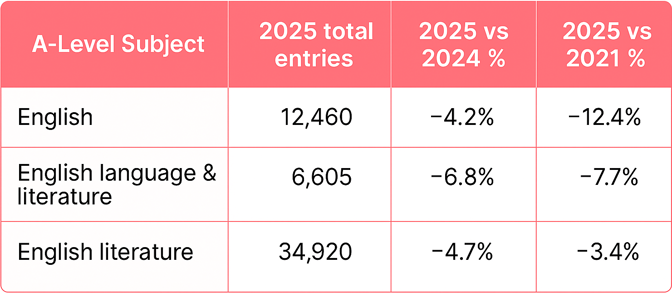
The growing gap between rising GCSE English numbers and falling A-Level uptake highlights a clear need to review why students are opting away from the subject after age 16.
Curriculum Recommendations
According to the Department for Education review, 31% of students every year do not achieve A-Level 2 in English by the age of 16, and 20% do not achieve this by age 19, showing that a review of the curriculum is vital for such a core subject.
Government recommendations for the 2026/2027 academic year include:
- Introducing a diagnostic test for 12-year-olds, after over a quarter of pupils did not meet the expected standard in writing at Key Stage 2.
- Creating a speaking and listening (oracy) guide for schools to help teachers support students in the same way they do for reading and writing.
- Updating the current grammar, punctuation and spelling (GPS) test to add new tasks to see how students actually use these skills in their own writing.
Representative Pipeline Pressure (%)
Looking ahead to the workplace, we analysed a sample of 6,121 active UK job vacancies where advanced English skills would be non-negotiable. These range from investigative journalists, copywriters and creative speechwriters to SEN consultants and solicitors.
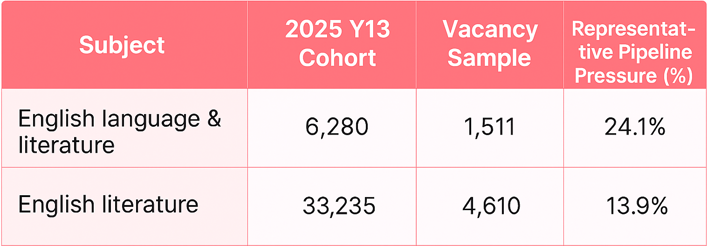
- English language & literature: Nearly 1 in 4 students is needed just to fill our sample of vacancies in specialist fields like UX writing and computational linguistics.
- English literature: Roughly 1 in 7 students is needed to fill current gaps in our sample of law and journalism vacancies.
This data shows that a single sample of jobs requires nearly a quarter of the national student output of possible talent, revealing that the pipeline of new professionals is reaching a critical bottleneck.
Maths
Like English, Maths is a foundational core subject in the UK through Year 11, serving as a vital gateway for higher education and most careers. While GCSE entries have surged by 19% over the last decade, over 116,000 Year 13 students had yet to secure a passing grade in the 2025 academic year.
Despite its importance, the transition to A-Level remains low, with only 19% of the 2024 GCSE cohort continuing the subject into 2025. This suggests that most students view Maths as a necessary ‘box to tick’ rather than a subject to master at an advanced level.
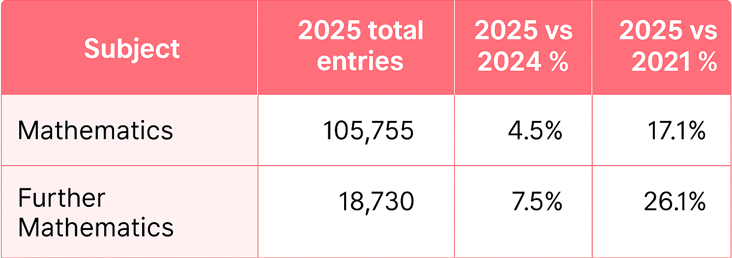
The simultaneous rise in both GCSE and A-Level Maths entries highlights a growing appreciation for the subjects, signalling a successful trend in student retention beyond age 16. However, reviews still need to be made to ensure students are at the standard to achieve a pass grade.
Curriculum Recommendations
There is growing national concern that the Maths curriculum introduces complex topics too quickly, followed by excessive repetition later on, often preventing students from mastering basic concepts before advancing. Analysis of past GCSE papers confirms that, without a solid understanding of these basics, students rarely pass, regardless of their 12 years of schooling.
Government recommendations for the 2026/2027 academic year include:
- Introducing a diagnostic test in Maths to be taken in Year 8, with the aim of supporting teachers to identify any weaknesses early on.
- Ensuring pupils are exposed to mathematical concepts early on that can then be used where appropriate in other subjects, for example in financial education in Citizenship.
- Working with the Standards and Testing Agency to update non-statutory Key Stage 1 tests and Key Stage 2 assessments.
Representative Pipeline Pressure (%)
While most jobs require a GCSE Maths pass, there is still a major skills gap waiting at the higher end of the job market. We analysed a sample of 5,297 active UK vacancies in specialised fields like investment banking, accountancy, and cryptography.
The Pipeline Pressure (%)
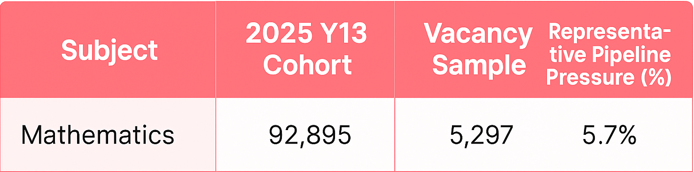
Nearly 1 in 18 A-Level Maths students (5.7%) are needed just to fill a small sample of finance and data roles. However, this same cohort of 92,000 students also provides the entire talent pool for engineering, physics, and medicine degrees nationwide.
When a single sector claims such a significant share of national output, it creates a talent vacuum across the rest of the STEM economy. This highlights a fragile pipeline: any dip in students progressing from GCSE to A-Level creates a permanent deficit of future experts. Without sustained engagement in Maths, the shortage of specialists for these vital roles will continue to worsen.
Computing
Computing’s popularity has surged over the last decade, with GCSE entries climbing by 40% and A-Level entries by 20%. As an optional subject, this growth is impressive, with GCSE entries now consistently exceeding 90,000, while A-Level numbers approach 20,000, revealing a clear shift in interest toward digital careers.
The 2025 exam data also highlights a trend of early achievement. While 87,300 students sat the GCSE in Year 11, only 150 students still required a pass by Year 13. This dramatic decrease suggests that the vast majority of students are mastering the curriculum early, leaving only a tiny fraction needing further support to cross the finish line by the end of sixth form.
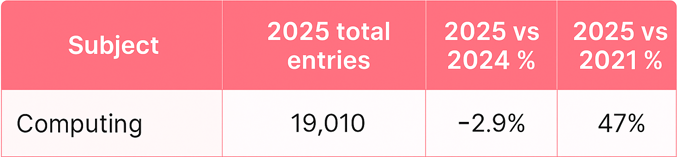
While Computing entries at both GCSE and A-Level saw a year-on-year decline between 2024 and 2025, this should be viewed against a decade of massive growth. Nevertheless, this recent downturn underscores the need for a targeted review to identify the factors driving the decrease.
Curriculum Recommendations
Students are more interested in technology than ever, yet classroom time is moving in the opposite direction. Since 2011, dedicated teaching hours for the subject have plummeted from 5% to a mere 2%. This disconnect highlights a critical need to overhaul how we teach computing to keep pace with a world dominated by AI and cybersecurity.
Government recommendations for the 2026/2027 academic year include:
- Clarifying what students should be taught so they can build essential digital literacy.
- Replacing GCSE Computer Science so the curriculum supports students to develop the digital skills they need for the future.
Representative Pipeline Pressure (%)
The tide is beginning to turn with some exam boards already weaving AI into their GCSE specifications. This development is vital, as we analysed a sample of 39,635 active UK vacancies in specialised fields like AI engineers and cybersecurity analysts.
The Pipeline Pressure (%)
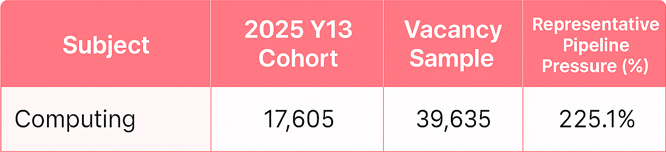
Even if every single A-Level computing student in England went directly into these roles, there would still be over 22,000 unfilled positions.
This data indicates that a critical sector is facing a pipeline collapse. If we want young people to flourish in these high-demand careers, the education system must move as fast as the tech world it serves. Without a massive expansion of the specialist pipeline, the UK’s tech ambitions will remain permanently unstaffed.
Science
Science is a compulsory UK subject through GCSE, with students taking either the ‘Combined’ or ‘Triple’ route. Beyond those pursuing medical or research careers, the data-handling and problem-solving skills learned are vital for nearly any professional path.
Our five-year data shows a steady trend in Year 13 retakes, including a small 7% rise in students still working toward a pass in Combined Science. This represents approximately 2,000 young people annually who are at risk of missing out on foundational scientific literacy.
However, once Science becomes optional at A-Level, participation remains high. In 2025, nearly 168,000 students chose to specialise in a science, with Biology leading at 66,000 entries, followed closely by Chemistry and Physics. This demonstrates that interest in the subject thrives even after it is no longer mandatory.
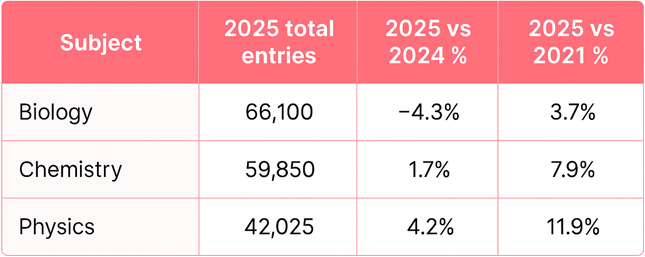
Despite a five-year upward trend in A-Level science participation, a recent dip in Biology entries indicates that curriculum reviews are still required to sustain long-term student engagement.
Curriculum Recommendations
Significant changes are being proposed for the science curriculum, with 31% of teachers advocating for the introduction of space science and the removal of electrolysis and electromagnetism. Parallel to this, students have spoken up about their own priorities, calling for greater focus on climate change to ensure the curriculum remains relevant to the global challenges in the real world.
Government recommendations for the 2026/2027 academic year include:
- Ensuring that the curriculum explicitly develops students’ understanding of the scientific principles that explain climate change and sustainability, and the global efforts to tackle them.
- Adapting practical activities to show explicit links to both key concepts and hands-on skills.
- Introducing an entitlement to Triple Science at GCSE, so that any student who wants to study it has the opportunity to do so.
Representative Pipeline Pressure (%)
While a science GCSE provides a versatile foundation, a significant gap exists between student numbers and specialised job vacancies. We analysed a sample of 1,731 active UK vacancies in specialised fields ranging from Forensic Science to Astrophysics.
The Pipeline Pressure (%)
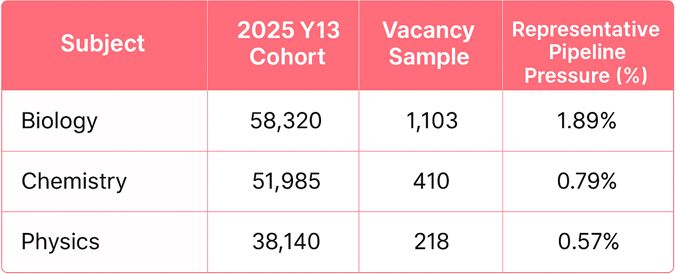
When contrasted with high A-Level enrollment, the supply of potential qualifiers in our sample appears to outpace niche market demand.
However, nearly 1 in 85 students would be required to fill this specific sample of high-end roles, underscoring the importance of pursuing advanced specialisms and deeper engagement for those determined to secure a career in these highly competitive fields.
Languages
Learning a second language is a core part of the UK curriculum, usually studied through GCSE to build communication skills and global awareness. Even for those not planning to work abroad, language study sharpens general literacy and provides a competitive edge in the global job market.
While GCSE enrollment has remained stable at around 290,000 over the last five years, there is a sharp decline in students pursuing these subjects at A-Level. Of the 2024 GCSE cohort, only 5% of French students continued to advanced study, while Spanish and German saw slightly higher, yet still modest, retention rates of 6%.
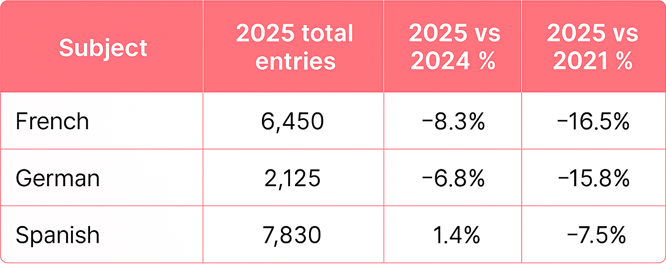
Apart from a year of growth for Spanish, the broader decline in language uptake suggests that the current offering is failing to engage students, requiring a need for review and necessary reforms.
Curriculum Recommendations
Language learning is currently held back by a lack of lesson time, with many students receiving less than two hours a week, which is hardly enough to build fluency. Progress is also slowed because students start secondary school at different levels, forcing teachers to repeat basic material.
Government recommendations for the 2026/2027 academic year include:
- Standardising core content for French, German, and Spanish and encouraging primary and secondary schools to coordinate on a single language.
- Standardising expectations on what ‘substantial progress in one language’ looks like.
Representative Pipeline Pressure (%)
Knowing a second or third language is a great boost for any career, but for some sectors, it is a non-negotiable requirement. We analysed a sample of 2,533 active UK vacancies in high-stakes fields including Intelligence Analysis (GCHQ), international sales, and global supply chain management.
The Pipeline Pressure (%)
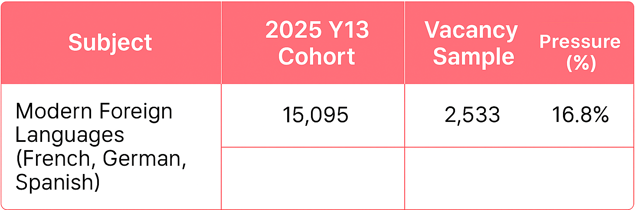
Nearly 1 in 6 students from the entire national A-Level cohort for the three main taught languages (French, German, and Spanish) is required just to fill our specific sample of vacancies.
Because roles in national security and global trade require years of linguistic and cultural experience, this 16.8% pressure could indicate a looming bottleneck.
For teachers, the challenge lies in encouraging students beyond the ‘box-ticking’ phase toward professional fluency. Without a curriculum that incentivises this long-term engagement, the UK risks exhausting the very talent pool needed for these specialist roles.
Tackling the Need for Curriculum Review
The path to improving GCSE results depends on making education feel relevant. Our findings suggest the UK curriculum must better align with modern workforce skills. While a full overhaul rests with the Department for Education, schools can take immediate action by weaving real-world career contexts into their lessons.
By highlighting the direct link between core subject passes and thousands of job vacancies, schools can significantly boost student motivation. Moving from a rigid academic focus to a career-connected approach ensures students aren’t just memorising facts for exams, but are building a meaningful foundation for their future lives.
To turn this vision into reality, schools can leverage Access Education's engagement software to create a more dynamic and supportive learning environment. Tools such as GCSEPod offer mobile-friendly content that fits students’ lifestyles, a method proven to significantly boost exam performance.
Meanwhile, platforms like My School Portal strengthen the connection between teachers, students, and parents, providing the insights necessary for academic success. By combining these digital tools with a curriculum focused on employability, schools can maintain student motivation and ensure they are fully prepared to excel in their GCSEs and beyond.
Education Consultant, Adam Speight, agreed with the need to reassess what topics are taught and how, saying:
“It is clear that many students are still falling short of achieving GCSEs in core subjects like Maths and English which are vital for the majority of career paths. Without these grades, young people face a much tougher road, possibly struggling to secure full-time employment, which can lead to long-term unemployment or significantly reduced lifetime earnings.
“While it is crucial for the government to act on these recommendations to protect the future of our workforce, schools don’t have to wait for policy changes. By doing everything possible to support and encourage students, especially those resitting exams in Year 13, and by emphasising why that pass grade matters, schools can drive real change. Focusing on student engagement today is the best way to boost GCSE success rates and, ultimately, increase the number of students moving on to higher level A-Level subjects.”
Methodology
For the report, Access Education analysed Department for Education data on provisional exam entries for GCSE, AS, and A-Levels across a seven-year span (2016-2017 and 2021-2025). This analysis focused specifically on core and specialist subjects, including English, Maths, Computing, Science, and Languages.
This was then cross-referenced with trends in the current labour market demands by looking at active job vacancies on Reed that explicitly require qualifications in these fields.
Access Education further reviewed official government reports and curriculum recommendations to provide further evidence to support the growing necessity for a national curriculum update.