<!-- Bizible Script --> <script type="text/javascript" class="optanon-category-C0004" src="//cdn.bizible.com/scripts/bizible.js" ></script> <!-- End Bizible Script -->

AI in Manufacturing: Everything You Need to Know, From Benefits to Use Cases

The manufacturing industry has always benefited from technological breakthroughs, whether in automation or advanced data analysis. Today, we’re entering an industrial revolution which uses artificial intelligence (AI) in manufacturing to unlock further productivity gains.

To outcompete during the Fifth Industrial Revolution, otherwise known as Industry 5.0, manufacturing companies must investigate ways to streamline their processes. Of all the technology promising to do so, artificial intelligence enables the most wide-ranging solutions.

But how exactly does artificial intelligence in manufacturing enable companies to make efficiency gains? And what does the future of AI in manufacturing look like?

In this article, we'll outline the key benefits and challenges of adopting AI in manufacturing, break down the top trends and practical use cases, and provide actionable insights so you can develop a robust digital transformation strategy.

8 minutes

Written by The Access Group.

Updated 14/10/2025

What is AI in manufacturing?

Artificial intelligence is a broad category, but at its core, it describes technology that can simulate human actions and thought processes. One of the most exciting advances in recent years has been Generative AI, which can generate content like text, images, and videos through text-based prompts.

Although generative AI can be employed in the manufacturing industry—for example, in creating customer service chatbots or new software code—it's not the only type of AI that can directly benefit the production side of the sector. 

When we talk about artificial intelligence in manufacturing, we're also referring to the use of machine learning (the ability to learn from data), computer vision (the ability to understand visual prompts) and robotics (the ability to perform physical tasks autonomously). 

Manufacturers have been using some of this technology for many years. For example, industrial robots have been a staple on production lines since the 1960s, while CAD has streamlined product design to allow for more complex manufacturing methods. 

More advanced types of AI, such as advanced machine learning models, are still in the early stages of adoption by the manufacturing industry. However, companies are doubtless optimistic about the benefits of these innovations.

Understanding AI is far more about attitude than business size. Both small and larger manufacturers can benefit from AI tools; the important thing is to have a growth mindset. The barrier for everyone is being educated enough to understand where it can have the biggest impact, and to understand what’s possible

Gary Sheader Founder of The Manufacturers’ Alliance

Why is AI So Important for Manufacturing?

AI technology is a major driver of the Fifth Industrial Revolution, enabling manufacturers to move beyond traditional automation and unlock new levels of efficiency. Manufacturing sector leaders identify three broad areas of manufacturing operations that are poised to benefit most from AI: predictive insights, decision-making, and planning. By integrating AI into their operations, businesses can speed up efficiency gains, respond more quickly to disruptions, and gain a competitive edge. 

Key benefits of AI in manufacturing include:

  • Faster Problem Identification:

Technologies like computer vision allow for the instant identification of production issues and defects. This enables a quicker response than human analysis alone, resulting in a 30-40% increase in first-pass yield for example.

  • Increased Production Optimisation:

AI-driven predictive analysis and inventory optimisation can lead to more efficient supply chains and a significant increase in throughput. In some cases, manufacturing companies have seen an increase of up to 140% thanks to trained AI models.

  • Redirecting Employees to Value-Added Tasks:

A crucial benefit of AI is its ability to handle repetitive and administrative work. By automating these processes, teams are freed up to focus on more complex, strategic problems, which unlock new opportunities for innovation and growth.

The Challenges of Adopting AI

Despite the optimism surrounding deploying AI in manufacturing, few companies are on their way to reaping the rewards of this technology. In the UK, manufacturing is the sector least likely to use AI technology already, pointing to a major gap between adoption and understanding of its full capabilities. 

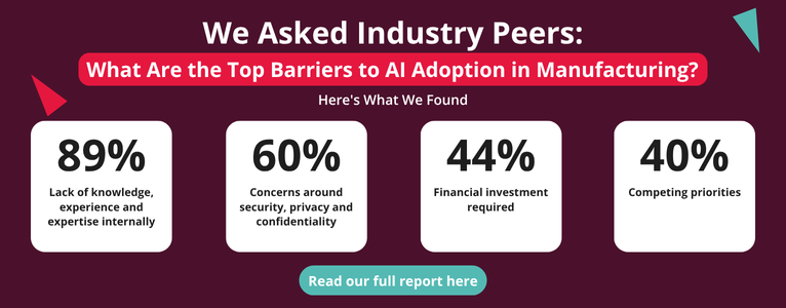
Among the common barriers to AI adoption in the manufacturing sector are employees' lack of technical knowledge and trust in AI in general. These barriers align with some of the technology's well-known risks and perceived downsides of AI in manufacturing.


Data security and integrity

Advanced machine learning models are built on vast amounts of data. While data collection is the norm in digital-forward manufacturing companies today, using large datasets to train AI can introduce significant cybersecurity risks. 

In a worst-case scenario, data breaches can cost companies millions in penalties from organisations like the Information Commissioner's Office (ICO). Plus, there are increased risks of data leaks via AI models trained internally on confidential company data, which could easily compromise company performance if disclosed. 

Poor quality data inevitably results in poor AI recommendations and solutions, and without confidence in the original data, building AI solutions can be a costly waste of time.

The cost of adopting AI

Cost is of particular concern for SMEs. Given increased costs across the supply chain, particularly in energy and raw materials, many companies will naturally hesitate to invest in AI, especially if the ROI and benefits are unclear.

Despite these significant obstacles, many companies are experimenting with AI in manufacturing, and in some areas of operation, the benefits undoubtedly outweigh the disadvantages.


What is the future of AI in manufacturing?

The use of artificial intelligence in manufacturing is still nascent for most small and medium sized manufacturers, but the sector is eager to reap the rewards of AI innovations. With most companies at least aware of the competitive advantages, if not already implementing solutions, to ignore AI in manufacturing is to fall behind. 

With Industry 5.0 on the horizon, the use of AI in smart manufacturing will only increase. Indeed, many of the goals of smart manufacturing and smart factories—streamlining traditional manufacturing operations and boosting efficiency—will only be achieved with AI-augmented or AI-led solutions such as those described above.

The Access Group is making AI in manufacturing more accessible

The Access Group is making AI in manufacturing more accessible by delivering solutions that integrate seamlessly with existing systems. Our AI-driven tools simplify complex processes, allowing businesses of all sizes to leverage predictive analytics and automation without a massive investment in new infrastructure or specialised talent. 

See how UK manufacturers harness the power of AI