AU & NZ
 SG
SG
 MY
MY
 US
US
 IE
IE


Why is Quality in Care Important?
High‑quality care is at the heart of supporting people to live with dignity, independence, and safety. When care quality is strong, individuals receive the right support at the right time, delivered with compassion and respect, not only improving day‑to‑day wellbeing, but helping people maintain control over their lives, feel valued, and experience positive outcomes that truly matter to them.
For care providers and teams, prioritising quality creates a healthier, more empowering working environment through clear processes, consistent standards, and a culture of continuous improvement reduce stress, prevent avoidable errors, and enable staff to focus on what they do best, all while providing meaningful, person‑centred support. In turn, this strengthens trust between people who use services, their families, and the professionals who care for them.
Across the wider health and social care system, good quality care plays a critical role in preventing crises, reducing unnecessary hospital admissions, and using resources more effectively. When services are well‑run and responsive, people receive coordinated support that meets their changing needs, easing pressure on other parts of the system.
Improving care quality means creating an environment where every person receives support that enriches their life, honours their choices, and protects their wellbeing with safety and consistency.
Quality in Care - How to Manage It
One of the best ways of managing quality in health and social care is auditing your services to see where they might be below standards and to identify where standards could be driven up further.
Before auditing your services, you should run a quick check on yourself. How do you see care audits? As a way of checking for problems? To generate evidence for the CQC or Care Inspectorate or RQIA? Or do you see them as a way to identify where and how you can make your care services better?
To make the most of audits you should be coming from the latter perspective. Because although care audits are indeed necessary to demonstrate to inspectors that you have proper oversight, at its core the audit is a Quality Improvement Process.
Various approaches to managing quality and improving it, often called Quality Improvement Methodologies have been developed, emerging from different countries, decades and sectors of the economy.
When it comes to health and social care, the Healthcare Quality Improvement Partnership (HQIP) have developed their own guide to the social care audit in practice, which utilises a model very similar to the Plan-Do-Check/Study-Act (PDCA) framework, first popularised by W. Edwards Deming, whom many consider to be the father of modern quality control.
Each of the four stages of this cyclical model have been adapted by the HQIP to fit to social care. For guidance when auditing, you may want to build in your regulators own measurements of what high quality care looks like. For example the CQC's Key Lines of Enquiry in England.
All UK regulators have frameworks similar in purpose to the KLOE, but each nation uses its own model and terminology, ensuring safe, effective and compassionate care.
The Memorandum of Understanding (MoU) is an agreement between Healthcare Improvement Scotland (HIS), Healthcare Inspectorate Wales (HIW), The Care Quality Commission (CQC), The Regulation and Quality Improvement Authority (RQIA), The Care Inspectorate (CI), and Care Inspectorate Wales (CIW). that sets out how the UK’s health and social care regulators work together, outlining the framework for their relationships and cooperation. It describes shared principles, responsibilities, and arrangements, such as information sharing, to support safety and high‑quality care across all four nations.
Incorporating these established measures into your quality improvement audit process will give you nationally recognised frameworks to assess your levels of care quality against, rather than relying upon internal conceptions of what high quality health and care looks like.
The Plan, Do, Check, Act (PDCA)
Stage 1: Plan & Prepare
Preparation for a care audit as part of an ongoing quality improvement cycle:
- Determine which quality problem you will audit, e.g. a known risk to people using services, or to staff, a high cost or high-volume activity, or incident or complaint trend
- Agree the criteria and standards of quality you aim to measure against
- Involve people who use services, and other interested parties, in setting your objectives, standards, and the processes you will use
Stage 2: Review Quality
Data collection to review quality may be quantitative - capturing numerical data, or qualitative - capturing people’s experiences, to check whether standards are being met:
- Determine the data you need to understand whether you are meeting the standards identified, e.g. to check nutritional care, one might use the criteria ‘All staff assisting people with their meals must have appropriate training to ensure people are given the time, help and encouragement they need to eat the food provided’
- Prepare appropriate data collection form or system, and pilot before use
- Collect the data
- Analyse the data, to determine whether or not you are meeting the standards set, and if not, why not
Stage 3: Improve practice
Understand where and why performance is not as good as it should be, agree how it can be improved, and develop and implement changes:
- Discuss the results with all those affected and develop a consensus on what needs to change, e.g. in the case of nutritional care, you might find that few staff have appropriate training and agree that the organisation should ensure staff are trained relevant to their role
- Agree how to address all issues identified, taking into account what is likely to be effective, feasible and affordable
- Prepare an action plan to address the issues, using a variety of methods designed to achieve better compliance – such as training, protocols, checking systems, e.g. in the case of nutrition, appetising food, provided in an environment conducive to eating well
- Identify those responsible for making sure that each required improvement action happens
- Implement agreed changes and ensure people take responsibility for the actions assigned to them in the plan
Stage 4: Sustain Improvement
Everyone with responsibility must ensure the changes they make lead to improvement, by reviewing changes over time in order to sustain them:
- Integrate approaches to sustain improvements in the way the team, department or organisation works
- Agree dates for further or ongoing review or data collection, considering how long it will take for changes made to impact upon people using services.
- Review performance further when changes have been made and time has elapsed, repeating the review as required and appropriate for continual improvement.
- Make sure the benefits of care audit are experienced by the people who use the services, e.g. in the case of nutrition, this might mean comparing people’s nutritional status after changes have been made, to that at the outset of the audit.
Lean Six Sigma
Another quality management and improvement methodologies, such as Six Sigma, which can be used instead of or alongside PDCA, especially by larger care providers who may have more mature quality management processes already or have larger datasets to analyse.
Lean Six Sigma is a combined improvement approach that uses Lean methods to remove waste and Six Sigma tools to reduce variation, helping services run more efficiently and reliably. It provides a data‑driven way to solve problems and improve outcomes, offering faster, more consistent processes that benefit both people receiving care and the staff delivering it
However, the issue with using models like Six Sigma for social care audits, is that they inherit many characteristics of the industries they were born in – typically manufacturing. There the focus is on making repeatable processes more efficient, stable and effective. Therefore, models like Sigma Six focus on setting a benchmark, before spotting and correcting deviations from this.
While this works on the assembly line, it is less applicable, or even desirable in social care, where the focus should be on quality, personalisation and individualised outcomes, with unavoidable variety between each person receiving and delivering care.
Further guidance on quality improvement in health and social care
The Health Foundation has published its own 'Quality Improvement Made Simple: What everyone should know about health care quality improvement'.
Alongside some of the practices we've discussed it talks about the importance of change management when implementing and maintaining quality improvement systems in health and social care. It also advises on solutions to some of the frequent challenges that research has identified in making quality improvement work and 'stick' in health and social care.
The Future of Care Quality Management - Easier, Reliable and Effective
The development of cloud‑based software is transforming how we approach quality improvement, offering social care services tools that are not only smarter but also kinder to the pressures teams face every day.
Access Care Compliance is one such solution, designed to closely follow the HQIP‑recommended audit framework while providing a ready‑made library of trusted audits you can rely on - or adapt - to suit your service. This built‑in support makes the early stages of quality improvement far simpler by guiding what to measure and how, in line with the Care Quality Commission’s Key Lines of Enquiry.
Most importantly, the system turns your audit findings into clear, personalised action plans, helping you see exactly what needs to change, what progress has already been made, and what still requires attention. This kind of clarity empowers teams to move forward confidently, ensuring meaningful, consistent improvements that genuinely enhance the lives of the people you support.
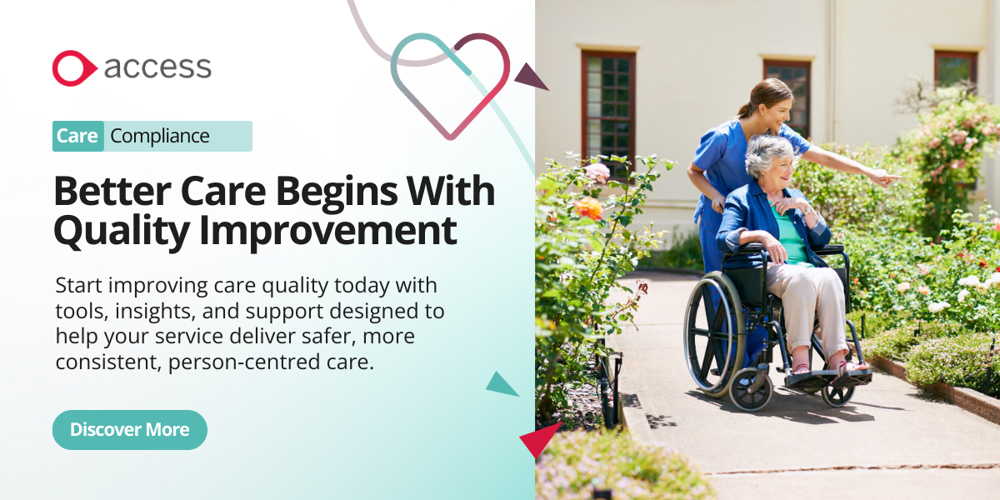
If you’re ready to make quality improvement easier, more reliable, and truly person‑centred, explore how Access Care Compliance can support your team and strengthen the care you provide.