AU & NZ
 SG
SG
 MY
MY
 US
US
 IE
IE


At Access Hospitality, we help operators stay informed as employment law changes alongside developing practical tools to help them navigate those changes with confidence.
In this article, we’ll explore:
-
what’s changing under the Employment Rights Act
-
when each phase is expected to land
-
why it matters specifically for hospitality
-
and what operators should be doing now to stay ahead.
Big picture: what is changing?
For hospitality leaders, the Employment Rights Act (formerly known as the Employee Rights Bill) is more than a legislative update. It will affect how labour is planned and costed, how managers handle people issues day to day, and how consistently businesses can operate across multiple sites. For operators with large, diverse teams, the changes raise the bar on record-keeping, decision-making and fairness in practice.
1. Stronger protections and enforcement
A new Fair Work Agency will oversee and enforce many of the reforms. It will have powers to inspect workplaces, bring tribunal claims on behalf of workers, and issue penalties where employers fall short.
Time limits for bringing employment tribunal claims in many areas are also expected to increase from three months to six months, which will give employees more time to challenge decisions and at the same time, it increases risk for businesses that don’t keep clear records or apply policies consistently.
2. Earlier access to key employment rights
Statutory sick pay will be available from day one of absence, with waiting days and the lower earnings threshold removed, widening eligibility for many hospitality workers who currently fall outside the system.
Access to paternity leave, unpaid parental leave, bereavement leave and pregnancy loss leave will also move to day one or very early in employment.
For operators, this means planning for protected time off that may arise with little notice, particularly in large or fast-moving teams.
3. Fairer hours and more predictable rotas
“Exploitative” zero-hours contracts will be banned. In their place, workers will gain the right to request a guaranteed-hours contract that reflects the hours they actually work over a set of reference periods. Compensation may also apply where shifts are cancelled or changed at short notice.
Employers will be expected to provide reasonable notice of shifts, limit last-minute changes, and be able to show that rota decisions align with working time rules, pay obligations and accurate record-keeping.
4. Dismissal, contract changes and unions
From January 2027, the qualifying period for unfair dismissal protection will reduce from two years to six months, with the current compensation cap expected to be lifted.
The Act will also place tighter restrictions on so-called “fire and rehire” practices, alongside stronger rules around union access, industrial action and protection against victimisation.
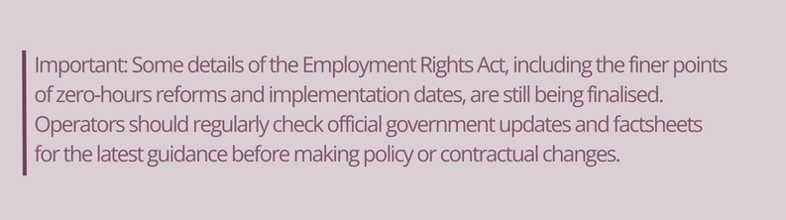
Employee Rights Act timeline: what happens when?
Below is a simplified timeline tailored to hospitality operations, giving operators time to start preparing early.
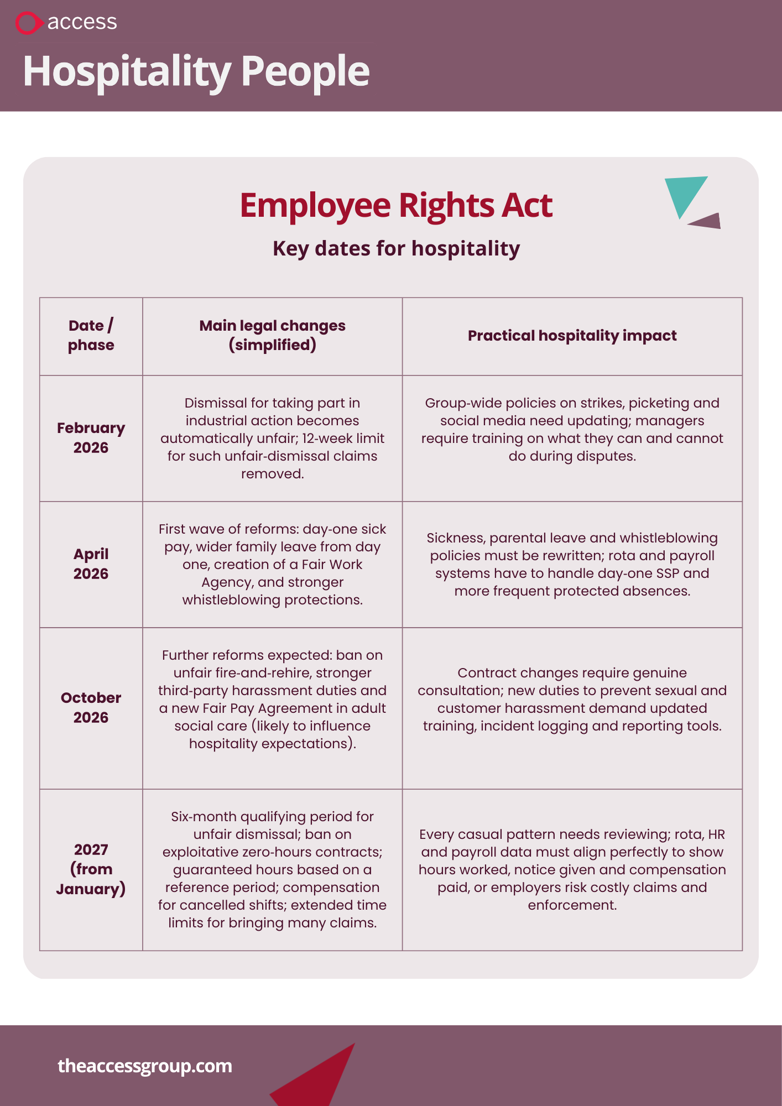
Key changes for hospitality operators regarding the Employees Right Act
Zero-hours, low-hours and shift workers
Hospitality’s reliance on variable-hours employees makes this one of the most significant areas of change under the Act, with around 28% of the UK accommodation and food workforce currently on zero‑hours contracts – the highest proportion of any industry.
Workers who regularly work certain hours over a reference period (expected to be around 12 weeks) will gain the right to request a contract that reflects those hours. Importantly, staff will still be able to opt into variable hours where flexibility genuinely suits them, but this will need to be a clear, informed choice.
Employers will also be required to give reasonable notice of shifts and to pay compensation where shifts are cancelled or significantly changed at short notice. For many operators, this introduces a direct cost to last-minute rota changes.
What this means in practice
-
Rota planning will need to be more consistent and evidence‑based, using tools that deliver accurate sales and labour predictions to minimise the need for late changes.
-
Accurate tracking time and attendance will also be essential, so you have a clear record of the exact hours each employee actually worked, not just what was planned.
-
Validation checks on the rota can flag when employees are scheduled beyond their maximum working hours or agreed limits, helping managers correct issues before shifts are published.
Sick pay and leave from day one
Hospitality has traditionally relied on statutory minimums, with many casual or lower‑paid workers missing out on sick pay because of earnings thresholds and waiting days, despite sickness absence rates hitting their highest level in around 15 years and being particularly high in caring, leisure and service occupations.
The Act removes both the lower earnings limit and the three waiting days for statutory sick pay, making more staff eligible from the first day of absence.
Day-one rights to paternity leave, unpaid parental leave, bereavement leave and pregnancy loss leave will also apply. This means managers must plan for protected time away from work that may arise with little notice and ensure staff are not disadvantaged in rotas or performance conversations as a result.
What this means in practice
-
Absence recording needs to be accurate and closely aligned with payroll, so statutory sick pay is calculated correctly and decisions are easy to evidence.
-
Scheduling processes should anticipate patterns in leave, for example around school holidays, so cover is planned in advance rather than arranged at the last minute.
Unfair dismissal, contract changes and disputes
Under the Act, employment protections arrive sooner, and poor process becomes more costly.
Unfair‑dismissal protection will apply after six months’ service rather than two years, which is especially significant in hospitality where reliance on short‑term and seasonal contracts has historically limited ordinary unfair‑dismissal claims. Recent research already shows hospitality and leisure businesses receiving around 12% more tribunal claims than the cross‑sector average, with many linked to harassment and discrimination.
The proposed removal of the unfair-dismissal compensation cap could significantly increase exposure in higher-value claims, particularly for senior or head-office roles.
At the same time, the Act will restrict the use of “fire and rehire” practices and strengthen protections around union activity and industrial action.
Employers will be expected to consult meaningfully on contract changes, clearly documenting the options considered and the reasons for any proposed changes. Claims linked to victimisation or dismissal connected to lawful union activity are also more likely to succeed without strong evidence and process.
Harassment, tips and fair work
The government also plans tougher duties around harassment prevention and fair treatment of pay and tips.
Employers will be required to take “all reasonable steps” to prevent sexual harassment and other unlawful harassment, including harassment by customers. For hospitality businesses, where customer interaction, late-night trading and alcohol can increase risk, this places greater emphasis on training, reporting routes and manager response.
Changes to tipping rules will also tighten requirements around how service charges and gratuities are distributed, limiting the ability for businesses to retain a disproportionate share rather than passing them on to staff.
Why the Employment Rights Act matters for hospitality operators
Legal and financial exposure
Longer time limits for tribunal claims, higher potential compensation and a more active enforcement body all increase the consequences of getting things wrong.
In 2023/24, the average unfair-dismissal award was around £13,700, while maximum awards reached close to £179,000. Discrimination claims regularly result in far higher sums, particularly where poor process or inadequate records are involved.
For hospitality, a sector already seeing a steady rise in claims and with above-average exposure to harassment and discrimination allegations, this significantly increases the cost of weak processes, informal decision-making and inconsistent record-keeping.
Workforce, brand and ESG impact
Improved access to sick pay, more secure hours and stronger protections are widely expected to support better retention and engagement in hospitality, a sector with one of the highest churn rates in the UK. Recent benchmarking shows team turnover has fallen from around 75% to 67%, but it still remains far higher than in most other industries.
Financial security is also a key factor. Survey data consistently shows that more than three-quarters of hospitality workers report significant financial stress, highlighting how pay predictability, fair scheduling and access to sick pay can directly influence wellbeing, loyalty and performance.
Operators that respond well to the Act have an opportunity to strengthen their employer brand and demonstrate a genuine commitment to fair work. This supports broader environmental, social and governance (ESG) priorities around employee wellbeing, local employment and community impact and, in a competitive labour market, helps position fair contracts and predictable hours as part of what makes an employer attractive, not just compliant.
Day-to-day operational pressure
For managers, the challenge will be balancing labour cost, guest experience and compliance at the same time. Labour already represents around a third of revenue for many hospitality businesses, with recent analysis suggesting costs have risen to around 35% of sales and continues to climb as wage and regulatory pressures increase.
Guaranteed hours, compensation for cancelled shifts and expanded leave rights all add new considerations to everyday scheduling and people decisions. Without clear processes and reliable data, these pressures can quickly translate into rushed decisions and higher costs.
How hospitality operators can prepare for the Employment Rights Act
Let’s now dive into how you can start preparing for these upcoming changes.
1. Map your current exposure
-
List every type of contract currently in use: permanent, casual, zero-hours, agency and seasonal and identify roles where hours are already relatively consistent. Use this review to align contracts with actual working patterns where possible and to flag areas where current practices may create risk under new guaranteed-hours, notice or cancellation-pay rules.
-
Review recent rota and payroll data (for example, the last 12-26 weeks) to see which employees may qualify for guaranteed-hours contracts and where late rota changes are most common.
-
Identify policies that are out of date, including sickness, family leave, dismissal, disciplinary and grievance procedures, harassment and tipping arrangements.
2. Update contracts, policies and rota rules
-
Update contracts for zero- and low-hours staff to reflect new guaranteed-hours rights, notice requirements and compensation rules.
-
Refresh sickness and family-leave policies so day-one rights are clear, evidence requirements are proportionate, and links to scheduling are understood.
-
Introduce simple, consistent standards for rota changes, such as minimum notice periods, approval rules and when compensation is triggered.
3. Equip managers with clear playbooks
-
Provide short, practical guides on key risk areas such as managing probation in the first six months, handling grievances, consulting on contract changes and responding to union activity.
-
Deliver scenario-based training on topics like harassment, tips, sickness conversations and rota fairness, focused on real situations managers are likely to face.
-
Introduce standard forms for sensitive decisions, for example extending probation or declining a shift-change request, so the reasoning is consistently recorded.
4. Tighten data, reporting and audit trails
-
Make sure rotas, time-and-attendance and payroll all draw from the same source of truth for hours, rates and holidays.
-
Standardise how you record employee consent, sickness notifications, flexible-working requests and consultation on contract changes.
-
Track key indicators such as late rota changes, use of casual labour, absence patterns, grievances and early dispute signals.
5. Phase changes in ahead of deadlines
-
For multi-site operators: pilot new rota rules, guaranteed-hours approaches and sick-pay processes in a small number of venues, then refine before wider rollout.
-
Use pilots to test how changes are communicated to employees and gather feedback on what lands well.
-
Set out a clear internal roadmap, with milestones for policy updates, manager training, data clean-up and wider rollout.
Employment Rights Act readiness checklist
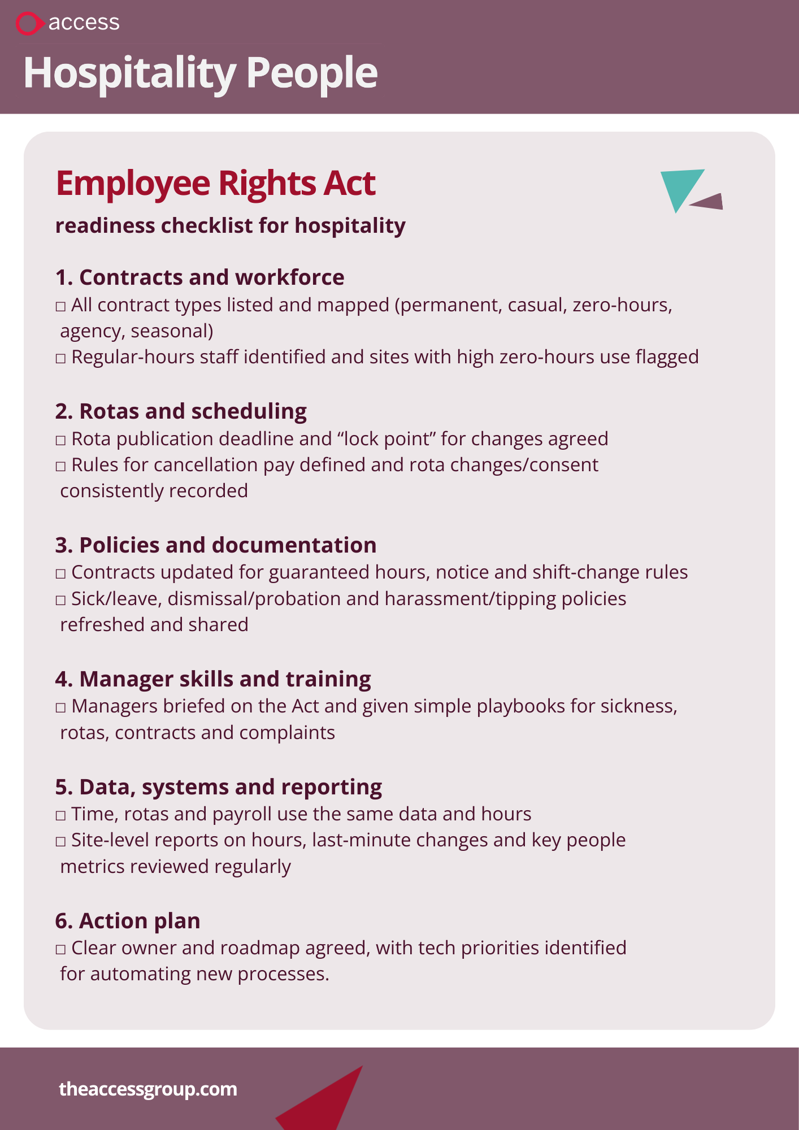
This quick‑view checklist is designed as a high‑level reminder of the main areas to focus on.
If you want a more detailed, printable workbook you can use with individual sites, download our Employment Rights Act Compliance Audit for Hospitality. It includes multi‑section checklists for contracts, rotas and records, plus action‑planning pages to help you close any gaps in your people solutions.
How Access Hospitality supports hospitality operators through Employment Rights Act changes
The Employment Rights Act raises expectations around fairness, predictability and evidence. Meeting those expectations consistently, especially across multiple sites, depends less on policy documents and more on how day-to-day people processes work in reality.
Our Hospitality People Suite, consisting of integrated recruitment, rota management, learning & compliance and payroll, is designed to support that shift by bringing core people data and workflows together, helping operators apply new requirements in a practical, repeatable way rather than through additional manual admin.
A single, reliable view of your workforce
By connecting recruitment, HR, rotas, learning and payroll, you get one source of truth for:
-
hours worked and average hours over reference periods
-
contractual obligations and guaranteed hours
-
pay applied, absence and leave
-
training completed and policy acknowledgements
This makes it easier to evidence decisions as enforcement becomes more proactive and tribunal time limits extend.
More predictable, defensible scheduling
Rotaready Evo, our HR & Workforce Management module, supports rotas that reflect contracts, availability, holidays and working-time limits, while giving you visibility of labour costs as rotas are built.
Key capabilities include:
-
Contractual obligation tracking, with colour-coded indicators showing whether guaranteed hours have been met
-
Advance rota publishing (for example, 2-3 weeks), with automatic employee notifications
-
Rota history and audit trails, capturing all changes
-
Live alerts for overtime, absence and understaffing to reduce last-minute changes
-
Average-hours calculations to support guaranteed-hours decisions
Clear contracts and policy records
Centralised HR workflows keep essential records in one place, including:
-
contracts and right‑to‑work checks
-
policy documents and employee acknowledgements
- legal e‑signatures and review reminders
Training records that evidence “reasonable steps”
Hospitality‑specific learning content supports compliance training across key risk areas, including:
-
harassment prevention and respectful conduct
-
core people policies and legal responsibilities
-
rota fairness, notice standards and absence processes
Accurate pay, absence tracking and transparency
Payroll draws directly from rota and HR data, helping ensure:
-
approved hours, rates, holiday and sick pay are calculated correctly
-
day-one sick pay and guaranteed hours are applied consistently
Configurable absence types (for example sickness, bereavement and parental leave) can be tracked from day one and passed through to payroll accurately.
Employee self-service access to payslips and pay history improves transparency and reduces disputes.
Supporting retention alongside compliance
When predictable rotas, accurate pay and clear protections are backed by consistent data and processes, you are better placed to improve retention and strengthen your employer's reputation, while staying on top of new employment requirements.
Strengthen your people processes with Hospitality People Suite
In this article, we’ve looked at what the Employment Rights Act is changing, when key milestones are likely to land, and what those shifts mean for hospitality employers in practice.
If you want to understand how these changes affect your business specifically, speak to our team to learn how our Hospitality People Suite can support your response to the Act. You can also visit our Employment law & rota compliance hub for practical guidance and best-practice resources created for hospitality.