AU & NZ
 SG
SG
 MY
MY
 US
US
 IE
IE


Far-reaching consequences
In the immediate present, the consequences of such a high number of teacher shortages are proving damning. School leaders have been increasingly forced to use non-specialist teachers, which in turn threatens to drive down pupil attainment, impacting the quality of teaching and learning.
Those that remain in the profession are finding themselves at increased risk of burnout - recently named as one of the top teacher stresses - as when the workforce shrinks, other teachers have to pick up further workloads, often without the proper capacity to do so.
NFER also found that schools which reported teacher recruitment as the most difficult were considerably more likely than other schools to have school leaders doing more teaching than usual. This threatens to reduce the school’s leadership capacity, and consequently limit the school’s ability to function well operationally, particularly without school management software or other solutions in place.
The 2023 Teacher Vacancies Report
With data so far providing the means to accurately inform on the teacher vacancies crisis, we wanted to explore how the situation fared across the UK, to find out if some areas are being disproportionately affected by the teacher shortages and where resources could be directed.
For the largest 50 towns and cities in the UK, we collated 2022 Census data on the number of teachers per city and compared this with the number of current teaching vacancies*, to find out where there were the lowest number of teachers per vacancy.
Where are the biggest teacher shortages?
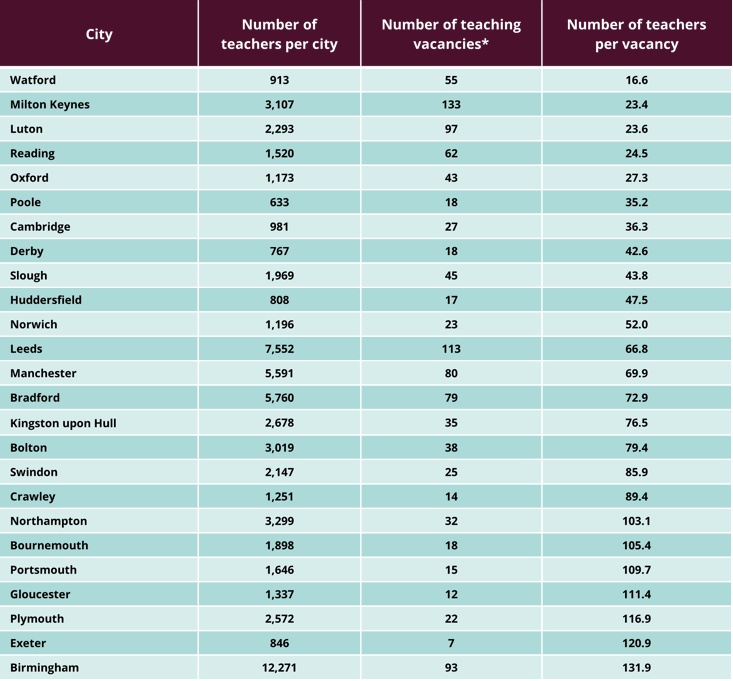
* in a 5-mile radius
Watford was found to have the biggest teacher shortages. With only 16.6 potential teachers per vacancy, it was the only location to not have over 20 teachers available.
Milton Keynes held the second highest number of teacher shortages (23.4 teachers per vacancy), with Luton closely following in third (23.6 teachers per vacancy). Out of the top 10 areas with the biggest teacher shortages, 8 were located in the South of England, implying this is the region where the teacher vacancies crisis is felt the most.
Where are the fewest teacher shortages?
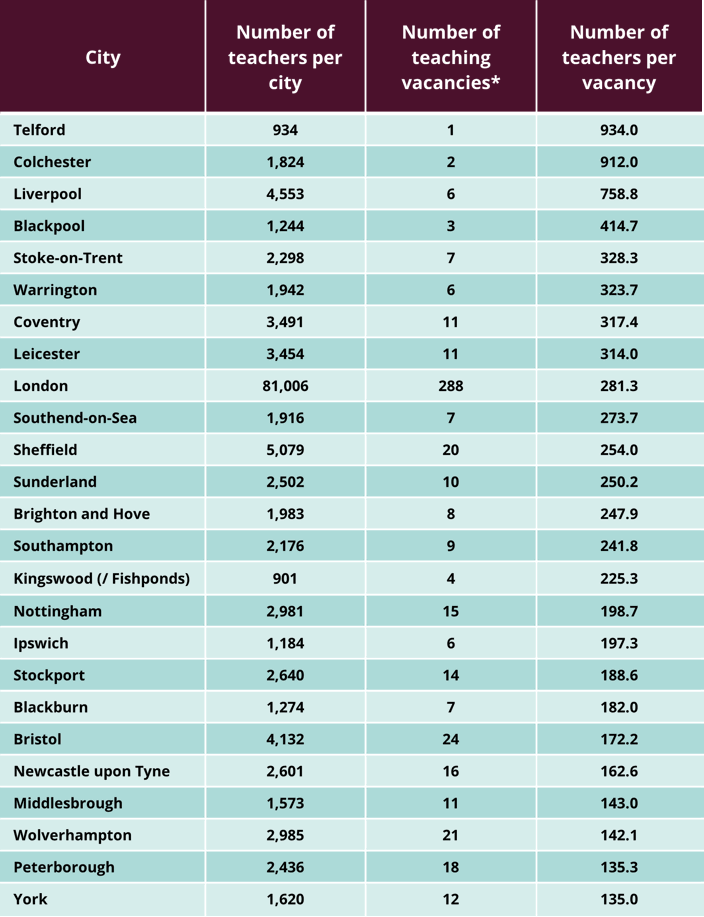
Out of the UK’s 50 largest towns and cities, Telford, had the fewest teacher shortages, with 934 teachers available per vacancy. This was over 56 times higher than Watford’s 16.6 teachers per vacancy.
Colchester had the second-fewest teacher shortages (912 teachers per vacancy) and Liverpool the third-fewest (758.8 teachers per vacancy), with the numbers dropping for Blackpool (414.7 teachers per vacancy) in fourth place and Stoke on Trent (328.3 teachers per vacancy) in fifth place.
In light of headlines earlier this year about Londoners turning their backs on teaching, London was revealed to have the ninth fewest teacher shortages in the UK, with 281.3 teachers available per vacancy.
Fixing teacher shortages
When so many towns and cities across the UK are currently affected by significant teacher shortages - even those who may have the least shortages compared to others - fixing the vacancies crisis sadly is not a simple fix, but instead requires a multi-faceted approach from various different angles.
Having been identified as one of the reasons why teachers leave the profession in the first place, time spent on admin is not only time-consuming but acts as a distraction. Alleviating this with school HR software has never been easier - allowing school staff to focus on what really matters.
HR and payroll software for schools is designed to streamline and automate HR administration - increasing efficiency, accuracy and compliance. As part of this, education payroll software is key to ensuring everyone is paid the right amount, at the right time - vital to support and value teachers.
Ex-teacher and Digital Content Manager at Access Education Richard Newsome, commented:
“The rising number of teacher vacancies is continuing to cause concern in the education sector, with Headteachers warning that the UK is now facing a ‘dangerous’ teacher shortage as the recruitment crisis deepens.
“We’re seeing this ring true in schools up and down the UK - even in areas which have the least shortages in comparison to others. In turn, school leaders have been increasingly forced to use non-specialist teachers, which threatens to drive down pupil attainment and impacts on the quality of students’ learning.
“Various solutions have been proposed, ranging from incentives like Labour’s proposal to give teachers £2,400 in the early stages of their career, to a greater management of staff, facilitated by technologies like school HR software. The way forward must be a multi-faceted approach, which tackles the problem from every angle.”
Why some areas are struggling more than others
Teacher shortages don’t spread evenly across the country. In some places, schools talk about recruitment as a mild challenge; in others, leaders describe it as the single biggest factor shaping their timetable. A mix of practical, economic and demographic forces sit behind the most affected regions.
In high-cost areas, salaries haven’t kept pace with living expenses, making it harder for early-career teachers to settle. Coastal and rural communities often face the opposite problem — fewer applicants and a smaller local talent pool, even when schools are well-funded. Large towns in the South and South East sit somewhere in the middle: attractive places to live, but close enough to major cities that graduates are pulled toward private-sector roles.
The result is a patchwork. Two schools just a few miles apart can face completely different staffing realities, depending on transport links, housing costs, and the local jobs market. The data highlights shortages, but the lived experience behind those numbers varies dramatically.
Methodology
To identify the areas in the UK with the biggest teacher vacancies, the Access Group listed the top 50 cities and towns in the UK based on population size and used 2022 Workforce Census data to find the number of teachers currently working at schools in each of the cities and towns.
Following this, the team used the government Teaching Vacancy Tool to find the number of current vacancies in these cities (within a five mile radius), correct as of July 2023. To work out how many teachers there are in each city per vacancy, the team then divided the number of teachers by the number of vacancies, resulting in a ranking of the cities with the greatest shortage, to the least.