

 UK
 SG
 MY
 US
 IE

The 2026 report, produced by the Australian Payroll Association and supported and sponsored by The Access Group, draws on responses from 467 payroll, HR and finance professionals surveyed in August and September 2026. The 2025 survey covered 856 employers, so year-on-year comparisons in this article are directional rather than exact.
The short answer from the research is that adoption is moving faster than confidence, skills and governance. This article sets out what the data shows and what payroll leaders can do about it.
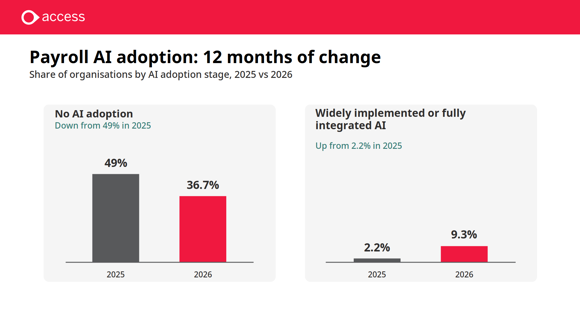
Figure 1. Source: Australian Payroll Association, Payroll AI Adoption Reports 2025 (856 employers) and 2026 (467 payroll, HR and finance professionals). Year-on-year comparison is directional because the samples differ.
Adoption is growing, but most of the movement is into pilots
The 2026 figures show where organisations sit today. 36.7% have not adopted AI, 31.5% are running limited pilot projects, and 20.0% have automated some processes. A combined 9.3% have reached widely implemented or fully integrated AI.
Most of the change has been a shift from no activity to early testing. For most organisations, payroll AI is still under evaluation rather than embedded in day-to-day operations.
Organisation size still matters. Enterprises lead, with 72.0% running at least a pilot. Small employers and bookkeeping practices report the highest no-adoption share at 47.2%, which the report links to cost, limited internal resourcing and fewer AI tools designed for smaller payroll environments.
The takeaway: Many organisations are at a decision point. The choices they make over the next year will shape how payroll AI is governed for years.
The decision has moved up the org chart
Last year, payroll professionals were the most cited initiators of AI adoption, at 14%. This year the picture has changed. Executive leadership is now most often involved in the decision to adopt AI, cited by 37.7% of respondents. IT departments follow at 30.8%, and payroll teams at 25.4%.
That shift brings welcome visibility. AI is being treated as a governed, cross-functional initiative rather than a grassroots experiment. It also carries a risk. When executives and IT lead decisions without enough payroll expertise in the room, the features that look impressive on a slide may not match how payroll works, including award interpretation, compliance deadlines and exception handling.
The takeaway: Bring payroll into the room early. Its operational and compliance knowledge should shape AI decisions, not just implement them.
Trust and skills now sit between interest and action
When asked to name their top barriers to greater AI adoption, respondents ranked data privacy and security first (53.8%). A lack of internal AI knowledge or skills came second at 38.7%, ahead of compliance or regulatory concerns at 30.3%. Payroll software that does not yet offer suitable AI features was named by 26.4%.
The internal skills gap is the notable change. Payroll professionals are no longer only asking whether AI can be trusted with sensitive data. Many are now asking whether they and their teams know enough, or understand how it works within their payroll systems.
Confidence is improving, but slowly. Only 9.9% of respondents describe themselves as very confident in their understanding of AI in payroll in 2026, up from 5% in 2025. More than a third remain not very confident or not at all confident.
Attitudes to risk are more measured. 69.1% believe there is some risk that can be managed with proper controls, while 20.4% see the risk as significant. Only 5.0% consider the risks minimal. The profession broadly accepts that AI has a role but wants that role bounded by clear safeguards.
Payroll AI governance: the most urgent problem
The gap: 46.6% of organisations have no AI governance framework, and only 1.1% have a documented AI policy specific to payroll.
Use is also outpacing policy. Almost one in four workplaces report some unsanctioned use of public AI tools such as ChatGPT, Claude or Gemini. Only 34.3% report approved-only use. For a function that handles highly sensitive employee, financial and personal information, that gap matters.
Payroll data deserves a higher level of protection than many employees realise. Payroll records can contain salary information, bank account details, tax file numbers, superannuation information, home addresses, leave records and other personally identifiable information. Entering this data into public AI tools that have not been approved by your organisation can create significant privacy, security and compliance risks.
As a practical rule, payroll professionals should never paste employee records, pay run data, banking details, tax information or other confidential payroll information into publicly available AI platforms unless those tools have been formally approved, assessed and governed by their organisation. Where AI is used, sensitive information should be de-identified wherever possible, access controls should be enforced, and employees should understand exactly what information can and cannot be shared with AI systems.
A practical starting point for payroll operations is a minimum AI policy that covers:
• Approved tools: a short list of AI tools that staff may use for payroll work
• Data rules: what employee, bank and tax information may never be entered into a public tool
• Human review points: which outputs must be checked before they affect a pay run, a payslip or a compliance report
• Training: a minimum level of AI literacy before staff use AI in payroll processes
• Incident response: what to do if sensitive data is entered into an unapproved tool
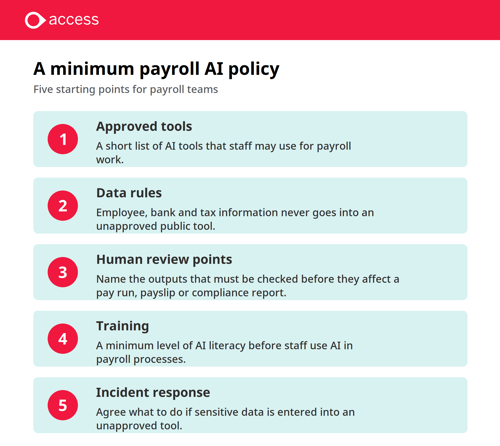
Figure 2. A minimum payroll AI policy: five starting points for payroll teams. Source: Australian Payroll Association, 2026 Payroll AI Adoption Report. Suggested starting points for discussion; adapt to your organisation's obligations and approved tools.
The takeaway: Governance needs to catch up with practice. Protecting payroll data must be central to that effort. Setting clear rules for how AI tools can be used, what data can be shared, and where human oversight is required is far easier than repairing a privacy breach or lost employee trust after the fact.
The vendor trust blind spot
Payroll teams assess AI not only within their own organisations. They are also assessing the AI their software providers offer, and many cannot see clearly.
68.7% of respondents do not know whether their payroll software provider holds independent AI governance certification, such as ISO/IEC 42001. Only 7.9% could confirm that their provider does. Around one in five (21.8%) also do not know whether their payroll software has AI capabilities at all.
The report's message for providers of AI-powered payroll solutions is that capability alone is not enough. Transparency about governance, security, data handling, human oversight and independent certification will matter as much as functionality.
The same logic applies to buyers. Before committing to any payroll platform, ask:
- Which AI features are switched on by default, and which can be turned off?
- Where is payroll data processed and stored, and is it used to train external models?
- How are AI-generated outputs audited, and who signs them off?
- Does the provider hold independent AI governance certification, and what is its scope?
- What training and documentation will our team receive?
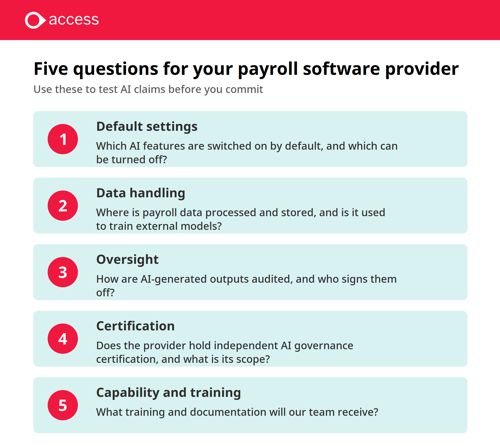
Figure 3. Five questions for payroll software providers. Source: Australian Payroll Association, 2026 Payroll AI Adoption Report. Questions are suggested for discussion.
The Access Group is ISO/IEC 42001 certified, reinforcing our commitment to the responsible, ethical and secure development and deployment of AI. As the world's first international standard for Artificial Intelligence Management Systems (AIMS), ISO/IEC 42001 provides a framework for AI governance, risk management and accountability, helping us deliver innovative AI solutions our customers can trust. Learn more: Responsible AI Solutions | Ethical AI & Data Security with Access
Keep a human in the loop
The research points to a clear preference. The largest group, 42.1% of respondents, would like AI to handle routine tasks, with humans reviewing exceptions. Only 4.5% are comfortable with high or full AI autonomy.
That preference is sensible. Payroll errors affect people's pay, taxes, and entitlements, which means human oversight remains essential for payroll accuracy as automation expands.
The question isn't whether AI can act, but where people should check its work.
Day-to-day impact is still modest. 28.7% of respondents report no noticeable change in workload, and 9.7% report a decrease. The report links this to the implementation and oversight work that often accompanies early adoption.
The takeaway: Match autonomy to trust, not ambition. Rollouts that let AI handle routine work while flagging exceptions for people are more likely to build confidence than rollouts that move faster than their users.
Building AI capability among payroll professionals
Payroll professionals' appetite to learn about AI is clear. The provision of training is not.
Only 3.7% of respondents have received formal AI-in-payroll training, while 61.8% say they want it. A further 29.1% rely on informal sources such as webinars and articles. The priorities are sharpening, too. Understanding how AI works in payroll systems is now the top skills priority, rising from 70% in 2025 to 80.3% in 2026. Risk management and compliance have risen from 60% to 72.3% over the same period.
Respondents also want practical ways to build those skills. 87.7% want to take part in AI conversations and events over the next year, and webinars, case studies and user communities are among the resources they say they want most.
The takeaway: Organisations that invest in capability now will move ahead of those waiting for a finished technology stack.
Four priorities for payroll leaders
The report closes with four priorities for payroll management as organisations move beyond pilots:
- Close the skills gap deliberately. Formal training remains rare, so investing here can be a differentiator.
- Put governance in place before scaling up. Policy, approved tools and data controls should lead the rollout.
- Match autonomy to trust. Start with routine tasks under human review.
- Bring payroll into the decision room. Payroll expertise should shape the choices that executives and IT make.
The future of AI in payroll: closing the gap
Payroll AI is no longer a future conversation. 2026 research shows adoption rising, executives taking ownership, and a profession eager to learn.
The remaining gap is one of confidence, skills, and governance. Closing it is the real work ahead, and payroll leaders can start now.
Get the full insights
How does your organisation compare? See where payroll teams stand on AI adoption, confidence and governance. Download the report
The 2026 Payroll AI Adoption Report was produced by the Australian Payroll Association and supported and sponsored by The Access Group.