

 UK
UK
 SG
SG
 MY
MY
 US
US
 IE
IE

Introduction
As organisations look for ways to improve efficiency and gain deeper workforce insights, many are evaluating AI payroll software vs traditional payroll. The comparison is becoming increasingly relevant for businesses managing more complex compliance, reporting requirements, workforce arrangements, and payroll data.
Payroll automation and artificial intelligence are not the same. Automation completes tasks according to configured rules, while AI adds capabilities such as anomaly detection, pattern recognition, natural-language queries and AI-assisted analysis.
However, these new capabilities do not replace payroll professionals. Accurate payroll still depends on quality data, correct system configuration and human oversight. AI supports payroll teams by helping them investigate potential issues, reduce manual effort and access workforce insights more efficiently.
AI payroll vs traditional payroll at a glance
While both traditional payroll software and AI-enhanced payroll software can help organisations process payroll efficiently, they differ in how they analyse data, support decision-making and assist payroll teams.
|
Automated Payroll |
AI Payroll |
|
Follows predefined rules and workflows |
Adds pattern recognition and analysis |
|
Automates routine payroll tasks |
Helps identify trends and anomalies |
|
Executes configured processes |
Supports insight generation and decision-making |
|
Relies on structured logic |
Can support natural-language queries |
Traditional payroll software is not necessarily manual, and AI-enhanced payroll software is not necessarily autonomous. Traditional systems typically follow predefined rules and workflows, while AI-enhanced tools may add pattern recognition and analysis to help teams surface trends or anomalies and generate insights for decision-making. Both approaches still rely on accurate payroll data, correct rules and human oversight.
For more context on what organisations need to address before adopting AI, read The AI turning point in payroll and HR.
What is the difference between traditional and AI payroll software?
Traditional payroll software and AI-enhanced payroll software both help organisations process employee pay and manage payroll obligations. The key difference is how they analyse payroll data and support decision-making. Traditional systems rely on predefined rules and workflows, while AI-enhanced solutions add capabilities that can help identify patterns, surface insights and support analysis.
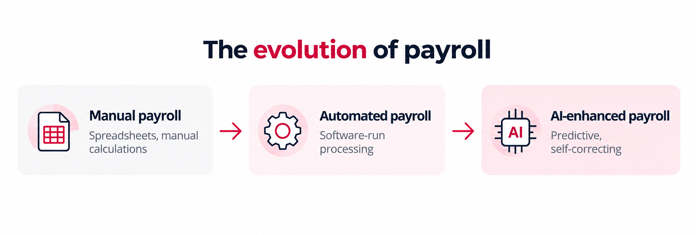
Traditional payroll software
Traditional payroll software uses predefined rules to calculate employee pay, deductions, taxes, leave entitlements and statutory reporting obligations. Modern systems automate many payroll tasks, helping organisations process payroll efficiently while maintaining established controls and approval processes.
For example, a payroll calculation may follow a simple rules-based process:
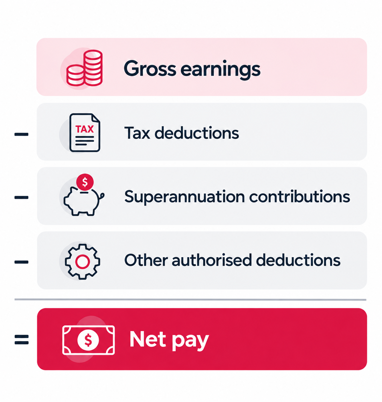
Example of a payroll calculation showing tax, superannuation and authorised deductions subtracted from gross earnings to calculate net pay.
While traditional payroll software can automate calculations and reporting, users often rely on standard reports, fixed validation checks and manual investigation to review payroll outcomes and resolve exceptions.
AI payroll software
AI-enhanced payroll software combines traditional payroll processing with additional capabilities that help users analyse payroll and workforce data more efficiently.
These capabilities may include:
- Anomaly detection that flags unusual patterns for review
- Pattern recognition across payroll and workforce data
- Natural-language payroll queries
- AI-assisted reporting and analysis
- More proactive identification of potential issues
For example, rather than searching through multiple reports, a payroll manager may be able to ask the system a question in plain English. This could include identifying overtime trends by department or flagging unusual leave activity that may require investigation. Importantly, payroll automation and AI are not the same. Automation follows predefined rules to complete tasks, while AI helps users interpret information, identify trends and uncover insights.
Regardless of the technology used, payroll professionals remain responsible for reviewing outputs, investigating exceptions and maintaining payroll governance. To explore AI’s wider impact on payroll, read our overview of how AI is transforming payroll management.
What are the limitations of AI in payroll?
While AI can help payroll teams analyse data and identify potential issues more efficiently, it works best as a support tool that surfaces insights and flags anomalies for review.
Importantly, AI cannot replace:
- Correct payroll rules and system configuration
- Accurate employee and workforce data
- Interpretation of awards, agreements and employment conditions
- Human review of unusual or high-impact situations
- Payroll governance and approval controls
- Data security processes
- Accountability for final pay outcomes
Organisations should also recognise that AI outputs are only as reliable as the data and rules they are based on. If payroll data is incomplete, inaccurate or poorly configured, AI-assisted analysis may produce misleading results.
An anomaly identified by AI is not automatically an error. For example, a sudden increase in overtime costs or an unusual leave pattern may be legitimate and require no corrective action. These findings still need to be investigated and validated by a qualified payroll professional before any decisions are made.
Ultimately, responsibility for payroll accuracy, compliance, governance and employee pay outcomes remains with the organisation. AI can support payroll processes and help identify areas for review, but accountability for final pay outcomes continues to rest with qualified payroll professionals and the employer.
Which payroll approach is right for your business?
The right payroll solution depends on your organisation's size, workforce complexity, reporting requirements and operational priorities. While traditional payroll software remains an effective option for many businesses, AI-enhanced payroll may provide additional value where workforce complexity, reporting demands or payroll data analysis requirements are increasing.
Traditional payroll software may be suitable if...
- Your workforce and pay conditions are relatively straightforward
- Existing payroll processes require minimal manual reconciliation
- Standard payroll reports provide the information your organisation needs
- Workforce size and complexity are relatively stable
- Your current payroll platform remains compliant, supported and fit for purpose
For organisations with predictable payroll requirements, a traditional payroll solution can continue to deliver efficient and reliable payroll processing without the need for advanced AI capabilities.
Consider AI-enhanced payroll if...
- Payroll teams spend significant time investigating exceptions and anomalies
- Reporting involves repeated data exports and manual analysis
- Workforce data is spread across multiple disconnected systems
- Employees work across multiple roles, rates or locations
- Business leaders require faster access to payroll and workforce insights
- Payroll complexity is increasing as the organisation grows
Managing employees across different roles, rates or awards? See how Definitiv can help simplify complex payroll.
What should Australian businesses consider?
When evaluating payroll software, Australian businesses should look beyond AI capabilities alone. It's important to assess whether a solution can support local payroll requirements while maintaining the controls, accuracy and oversight needed for compliant payroll processing.
Australian payroll requirements include:
- Modern Awards and enterprise agreements
- Single Touch Payroll (STP)
- Payday Super, with contributions due within seven business days of payday.
- Penalty rates, allowances and leave loading
- Fair Work record-keeping obligations
- Audit trails and approval controls
Australian payroll comes with a range of compliance obligations that significantly influence payroll processes and software requirements. For a deeper look at these unique challenges, read our guide to the 10 compliance requirements that make Australian payroll unique.
These requirements can add significant complexity to payroll processing, particularly for organisations with large, multi-site or award-covered workforces. When evaluating AI-enhanced payroll software, ensure any AI capabilities work alongside established payroll rules, controls, and compliance processes.
While AI supports payroll analysis, reporting and validation activities, responsibility for payroll compliance remains with the employer. AI may help identify potential issues for review, but it does not transfer accountability for payroll accuracy, legislative compliance or employee pay outcomes.
See smarter payroll in practice
TAMS streamlined payroll and reduced double data handling with Definitiv, estimating savings of $32,000 per year. Read the TAMS customer story.
How Definitiv supports smarter payroll management
For organisations looking to combine payroll processing with AI-assisted analysis, Definitiv brings payroll, workforce management and reporting together in a single platform. Rather than replacing payroll professionals, it helps teams access information more quickly, identify potential issues earlier and make more informed decisions using connected workforce data.
Key capabilities include:
- AI Copilot that allows users to ask payroll and workforce questions in plain English
- AI-assisted analysis and anomaly detection to help identify unusual patterns that may require review
- Custom dashboards and real-time reporting for improved visibility across payroll and workforce data
- Payroll, rostering and timesheets within a single platform to reduce data silos and manual processes
- A single employee record that supports multiple roles, pay rates and awards
- Reduced manual handoffs between workforce management and payroll teams
- Accessible payroll insights for payroll professionals, HR teams and business leaders
By connecting payroll and workforce management data, Definitiv can help organisations streamline reporting, improve visibility and reduce manual handoffs. This gives payroll teams more time to focus on exceptions, governance and business decision-making. Compare Definitiv plans to find the capabilities that align with your needs.
Ready to see smarter payroll management in action? Book a Definitiv demo or explore the interactive tour at your own pace.
Frequently Asked Questions
Is payroll automation the same as payroll AI?
No, payroll automation and payroll AI are related but they are not the same. In practice, AI builds on automation rather than replacing it.
Can AI replace payroll professionals?
No. While AI can reduce routine work and provide faster access to information, payroll professionals remain responsible for:
- Oversight and governance
- Managing exceptions
- Reviewing unusual or high-impact situations
- Compliance decision-making
- Final payroll outcomes
Does AI payroll software guarantee compliance?
No, AI can support compliance processes by helping organisations analyse payroll data and identify potential issues for review. However, compliance still depends on accurate data, correct system configuration and appropriate human oversight.
AI can help:
- Identify potential issues for review
- Support payroll analysis and validation
- Improve visibility into payroll data
AI cannot replace:
- Accurate employee and payroll data
- Correct system configuration
- Human review and approval processes
- Employer responsibility for compliance
Employers remain responsible for meeting their payroll obligations and maintaining compliance with relevant legislation.
Is AI payroll software secure?
As with any payroll system, protecting employee and payroll data should be a key consideration during the software evaluation process.
When evaluating AI payroll software, assess:
- Data hosting arrangements
- Encryption standards
- Access controls and permissions
- Audit trails and reporting
- Security certifications
- How payroll data is used by AI features
For more information, explore our guide to payroll software security.