

 UK
UK
 SG
SG
 MY
MY
 US
US
 IE
IE


Quick Answer Summary
Accounts receivable is simply the money customers owe you after you’ve delivered a product or service. Managing it well means setting clear payment terms, sending invoices on time, tracking outstanding invoices, and following up before payments become overdue. Metrics like days sales outstanding (DSO), AR turnover, and the cash conversion cycle (CCC) show how quickly you’re getting paid. When AR is managed properly, you reduce late payments, free up cash, and keep your business running smoothly.
Key Takeaway
- Accounts receivable (AR) is money your customers still need to pay you for products or services you've already delivered.
- Having a clear AR process, from setting payment terms to following up on invoices, helps reduce late payments and keeps cash flowing smoothly.
- Three key metrics to track AR performance are Days Sales Outstanding (DSO), AR Turnover Ratio, and the Cash Conversion Cycle, which show how quickly you're collecting payments.
- The faster you collect payments, the more cash you have available to pay employees, suppliers, and invest in business growth. That's why effective AR management has a direct impact on cash flow.
What is accounts receivable?
Accounts receivable (AR) is the money that customers owe your business for goods and services they have already received but haven’t paid for yet. In simple terms, the sale has been completed, and the invoice has been issued, but the payment is still outstanding. According to Investopedia, accounts receivable is recorded as a current asset on your balance sheet because the business expects to receive the money in the near future.
Accounts receivable in one sentence
Accounts receivable is the money customers owe you for goods or services delivered on credit, recorded as a current asset until payment is received.
Accounts receivable vs accounts payable
Accounts receivable (AR) and Accounts payable (AP) both involve unpaid invoices, but they affect your business in opposite ways.
|
Aspect |
Accounts Receivable (AR) |
Accounts Payable (AP) |
|
Definition |
Money owed to your business by customers
|
Money your business owes to suppliers or vendors |
|
Cash flow |
Represents money coming in |
Represents money going out |
|
Balance sheet position |
Recorded as a current asset |
Recorded as a current liability |
|
Created when |
You sell on credit
|
You buy on credit |
|
Example |
A customer has 30 days to pay an invoice you issued |
Your supplier gives you 30 days to pay for purchased inventory
|
The accounts receivable process
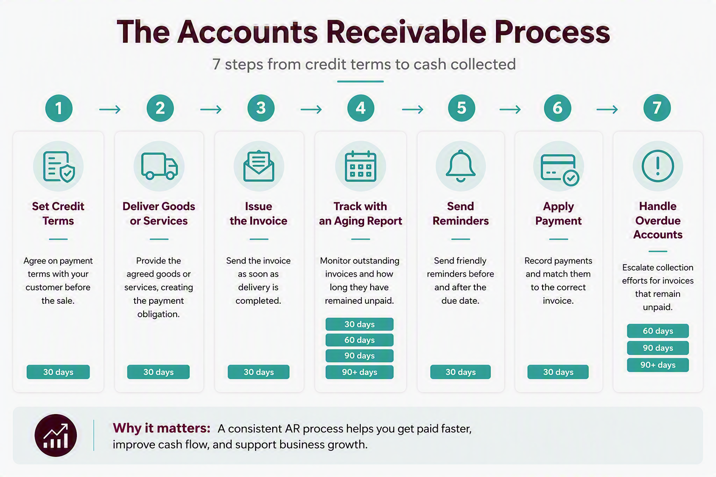
A good accounts receivable process begins when the invoice is issued. It helps set clear expectations, monitor customer balances, and ensure follow-up before payments are overdue. Here's how it works from start to finish:
-
Step 1: Set credit terms
Before you extend credit to a customer, agree on payment terms such as 7, 30, or 60 days. Make sure the terms are in writing and that your customer has acknowledged them. Unclear payment terms are among the most common reasons for overdue payments or invoice disputes. -
Step 2: Deliver goods or services
The moment you deliver the agreed goods or services, the transaction moves into the accounts receivable stage. Whether it's shipped product, a completed project, or a delivered service, the customer now owes payment, and the invoice can be issued. -
Step 3: Issue the invoice
Issue the invoice as soon as the agreed goods and services have been delivered. A good invoice includes:- Amount due
- Payment due date
- Payment details
- Invoice number
Remember, a clear and straightforward invoice makes it easier for customers to pay on time.
-
Step 4: Track outstanding balances with an ageing report
Think of the AR ageing report as a health check for your receivables. AR ageing report groups invoices based on the duration of unpaid invoices, such as:- 0 – 30 days
- 31 – 60 days
- 61 – 90 days
- 90+ days
It helps to identify overdue accounts quickly and prioritise collection activities effectively.
-
Step 5: Send reminders
Don't wait until the invoice or payment is overdue to reach out to customers. Send a friendly reminder before the due date approaches. If payment is past due, follow up with a polite email first, then make a phone call if needed. Keep records of all communications in case there is a dispute. -
Step 6: Receive and apply payment
When a customer pays, match the payment to the correct invoice and update your records. This process, known as cash application, keeps your accounts receivable balance accurate and prevents following up on invoices that have already been paid. -
Step 7: Handle overdue accounts
Despite sending reminders, some invoices may still become overdue. If a customer has not responded to your emails or phone calls, it is important to take the next step and send a formal written notice. This notice should clearly outline the outstanding balance and provide a final deadline for payment. If the account remains unpaid after that, you may need to consider involving a debt collection agency or seeking legal advice. Acting quickly on seriously overdue accounts can significantly improve your chances of recovering the money owed.
A strong accounts receivable process helps you get paid on time, maintain healthy cash flow, and avoid unpaid invoices by setting clear terms and following up consistently.
A simple accounts receivable example
Let’s say a business sells $1,000 worth of products to a customer and gives them 30 days to pay. The customer receives the products immediately, but the business hasn’t received the cash yet.
Because the payment is still outstanding, the business records $1,000 as accounts receivable. In simple terms, that’s the money the customer owes. The sale is recorded as revenue, yet the cash hasn’t reached the bank account yet.
Thirty days later, the customer pays the invoice. This results in the business receiving $1,000 in cash and removing the $1,000 from accounts receivable.
The process is straightforward: a credit sale is recorded first and then converted into cash when payment is received.
Measuring accounts receivable
These metrics help you understand how quickly customers are paying and how effectively receivables are being managed.
|
Metrics |
What it shows |
Formula |
|
Days sales outstanding (DSO) |
Shows how long customers usually take to pay. A lower DSO means faster payments
|
DSO = (Accounts receivable ÷ Total credit sales) × Number of days |
|
Accounts receivable turnover (AR turnover) |
Shows how often a business collects its outstanding invoices. A higher turnover usually means faster collections.
|
AR Turnover = Net credit sales ÷ Average accounts receivable |
|
Cash conversion cycle (CCC) |
Shows how long it takes a business to turn its spending into cash from customers.
|
CCC = Days inventory outstanding + DSO − Days payable outstanding
|
-
Days sales outstanding (DSO)
- DSO shows the average number of days customers take to pay their invoice. A lower DSO means payments are coming faster, which helps maintain healthy cash flow. If DSO increases, it could indicate that customers are taking longer to pay.
-
Accounts receivable turnover (AR turnover)
-
AR turnover shows how often a business collects the outstanding receivable over a period of time. A higher ratio is usually a good sign, as it means customers are paying regularly and invoices are being collected efficiently. A lower ratio, on the other hand, could mean customers are paying slowly, or your credit terms need reviewing.
-
-
Cash conversion cycle
- CCC measures how long it takes for money spent on business operations to be converted back into cash from customers. A shorter cycle is better because it means cash is tied up for less time, helping the business stay financially healthy.
For example, if your company gives customers 30-day payment terms, but they take 60 days to pay, the DSO will increase, the AR turnover ratio will decrease, and the CCC will become longer. This means cash takes longer to return to the business, which can impact day-to-day operations and cash flow.
Together, these metrics give you a clear view of the health of your receivables. They can help you monitor payment collection, manage cash flow, and understand how efficient payments are converted into cash.
Why accounts receivable matters for cash flow
Accounts receivable play a critical role in your business cash flow. You may have made a sale and recorded it as revenue, but the cash only arrives when the customer's invoice is paid. This gap between earning and collecting can put pressure on your business.
Here are three common challenges due to poor AR management:
Tied-up cash
- Money sitting on unpaid invoices cannot be used to cover daily costs such as payroll, supplier payment, or business investment. For example, if a small business has $50,000 in unpaid invoices, it cannot use that amount to pay suppliers, cover bills, or invest in business growth until the customer pays. The more overdue invoices a business has, the less cash to support operations and growth.
Working capital pressure
- When cash is tied in receivables, businesses may struggle to cover day-to-day costs. Businesses may need to rely on loans, overdrafts, or other credit facilities to fill the gap. This can increase borrowing costs and reduce overall profitability.
Bad debt risk
- The longer an invoice goes unpaid, the more difficult it can become to collect. Following up on overdue invoices early can help businesses resolve payment issues before they become bigger problems.
For finance leaders interested in using AI to strengthen cash flow management, AI in Finance: A CFO’s Guide explains how AI can help predict payment behaviour and flag potential receivables earlier.
How software helps manage AR
There comes a point in many businesses when managing accounts receivable manually becomes unsustainable. Managing accounts receivable manually can be time-consuming and increase the risk of errors such as late invoices, missed payment reminders, or payments recorded against the wrong account. Accounts receivable software simplifies day-to-day receivables management by automating tasks that would otherwise be done manually. This gives finance teams better visibility over outstanding invoices and customer payment trends while reducing time spent on administrative tasks.
The benefits of automation in finance go beyond saving time. Automation can help reduce manual errors, make the collection process more consistent, and give finance teams better visibility over customer payments. Finance automation can take some of this pressure off. Invoices and payment reminders can be sent automatically, and incoming payments can be matched to the correct invoices. This means finance teams can reduce spending on manual admin and are able to check payment information about payments due and follow up more easily.
Many modern financial management systems also include features such as credit control and bank reconciliation, allowing businesses to manage the full accounts receivable process in one place. This can reduce the need to move between different systems, make reconciliation easier, and give finance teams a clearer picture of their cash position. Learn more about financial management software.
Accounts receivable FAQs
Is accounts receivable an asset or liability?
An asset. It is money customers owe your business.
What is a good DSO?
Generally, under 45 days is a reasonable benchmark for most B2B businesses. The ideal DSO depends on your industry and payment terms.
What is the difference between AR and AP?
AR is money owed to you, while AP is money you owe to suppliers. Both affect your working capital and cash flow.
How do you reduce accounts receivable?
Invoice promptly, set clear payment terms, send reminders, and follow up on overdue invoices. For high invoice volumes, automating these steps makes the biggest difference.
How do accounts receivable affect cash flow?
Accounts receivable affect cash flow because unpaid invoices are revenue you've earned but not yet collected. The faster you collect payments, the stronger your cash flow and liquidity.
