UK
UK
 AU & NZ
 SG
SG
 MY
MY
 IE
IE


What is hotel guest experience and why it matters
Hotel guest experience is the difference between expectation and reality of what your guests experienced. From the moment their booking confirmation arrives in your inbox all the way to the post-stay email, it’s how every step influenced their hotel stay. And it’s their opinion that will serve as a guide to future guests who come across your hotel website to make their final decision.
These reviews will shape where the decision gets made. BrightLocal surveyed 1,002 US adults in February 2026 and found that 97% of them read reviews when evaluating a local business. More telling is that 41% now always read them, up from 29% the year before. Guest satisfaction in hotel businesses is a metric that separates the competition.
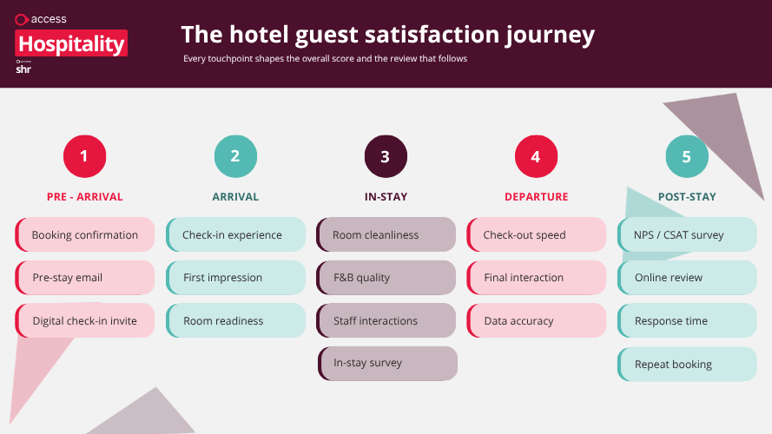
Understanding the factors that drive it is the first step in improving it for your hotel. Here are five things guests notice during a stay.
1. Cleanliness and room condition make all the difference
This is one of the top drivers for guest satisfaction scores, and it's where the industry has been putting its money. J.D. Power puts satisfaction with the hotel facility up 14 points year over year in 2026, with owner investment in guest rooms and upkeep named as the reason. Being clean and well maintained is no longer something that sets you apart, it's something guests assume. If your housekeeping teams aren't supported, this is where it shows first.
2. Staff friendliness and service speed deliver consistent service
When you're understaffed, guests will notice as pressure rises and service becomes slow. More than half of the 246 hotel owners and operators in the American Hotel & Lodging Association's Front Desk Feedback survey, fielded in late February 2026, described their property as somewhat or severely understaffed. So this isn't a small group of properties struggling on their own. When staffing levels are monitored well, teams can work efficiently and deliver exceptional guest experiences.
3. Check-in and checkout without the frustration
Long lines and wait times lead to frustration before guests have even got to their room. Many guests now expect self-service as it's on their own terms. The ones who would rather have a conversation still get one, because your front desk is free to have it.
4. Food and beverage quality that leaves guests wanting more
If you have a restaurant or bar in your hotel, then this is where guest experiences will be impacted. Reviews often feature pictures of food and drink, so cold food or slow service can be the downfall of guest satisfaction. Food and beverage was one of the three biggest movers in the 2026 study, up 14 points, so guests are noticing when it's done well.
5. Value for money, and what you are now required to show
This doesn't mean being the cheapest option available, but going the extra mile to make guests feel special. Value for prices paid was the single largest gain in the 2026 study, up 18 points, at the same time as rates barely moved, which tells you that value and price are not the same thing to a guest.
Transparent pricing is also no longer just good practice. Since 12 May 2025, the FTC's Rule on Unfair or Deceptive Fees has required any business advertising a price for short-term lodging to show the total price up front.
Mandatory charges like resort, destination and amenity fees have to be included in it. It applies to the platforms and travel agents selling your rooms as well as to your own site, and penalties run to $53,088 per violation. Make sure your rates, extras and cancellation terms are clearly communicated from the point of booking.
How to improve hotel guest experience
Here are six ways to improve hotel guest satisfaction that you can start on this week without a large budget. Consistency is key.
1. Nail the basics and get cleanliness right every time
Cleanliness is the driver that makes a good review a great one, as guests don't want to start their stay finding someone else's hair in the shower. If staffing is low or service gets busy, these standards may slip and guests will start to notice.
A practical way to get on top of this is by using a digital housekeeping checklist so teams work to a consistent standard no matter who is on shift. It enables them to meet deadlines and not cut corners even during the busier periods.
2. Give your team the confidence to fix problems on the spot
Ensure your teams are confident to resolve issues without needing to escalate them to higher management. The 2025 J.D. Power study found a problem occurs in only 12% of stays, but when one does, satisfaction falls 217 points, to 460 from 677.
Brief teams with a simple service recovery plan so they know what to offer and when, to defuse any tension before it escalates. This shows guests that they are being listened to and not passed around to different people.
3. Make arrival and checkout as painless as possible
Try using pre-arrival messaging that invites guests to complete a digital check-in to reduce desk pressure at busy times. It sets a positive tone before guests even walk through the door, and it means the team at the desk is dealing with the guest in front of them rather than the line behind.
4. Make guests feel known without overcomplicating it
You don't need an elaborate loyalty program to make guests feel known or appreciated. Use the data you already have like past stay comments, dietary preferences or room type choices to make small but meaningful changes that can influence their stay.
A welcome message that references a previous visit, or a room set up to reflect a guest's preferences, is what people remember.
5. Respond to all reviews promptly and professionally
When someone has a bad experience, the worst thing to do is retaliate as this is visible to everyone online. A brief and personal reply to a negative review demonstrates care and professionalism while showing prospective guests how you handle difficult situations.
Speed matters as much as tone now, as BrightLocal found 42% of consumers are unlikely to use a business that never replies to reviews, and roughly half of reviewers expect a response within a day of posting.
6. Happy teams make happy guests
Guests are important, but your teams need to be supported to deliver the best experiences. If they are overstretched or working long hours, it will show in service quality no matter how good your reviews have been.
Brief teams regularly to see if changes need to be made to their schedule and whether they are happy with the tasks assigned. If teams work well together, then this will positively impact your guest satisfaction and your scores.
How to measure guest satisfaction
Measuring guest satisfaction means choosing the right method for each stage of the guest journey, rather than sending guests multiple surveys once they have left. Here's how to build a plan that shows you what's working and where you can improve.
Catching problems before they become reviews
Sending a quick survey to guests during their stay gives you the opportunity to discover issues before they become a bigger problem. Keep it clear and simple, no more than three questions with a comment box for additional context.
A good starting question would be, "on a scale of 1 to 5, how satisfied are you with your stay so far?" Asked the morning after the first night, this gives you the clarity needed to fix concerns while the guest is still in the building.
Asking the right questions after their stay
A Net Promoter Score, or NPS, asks guests how likely they would be to recommend your hotel on a scale from zero to ten.
Promoters score nine or ten, passives score seven or eight and detractors score six or below, and your score is the share of promoters minus the share of detractors. That leaves you one number to track, which is a simple way to see whether guest loyalty is moving in the right direction.
The reviews are already out there, but are you keeping up
Where guests find those reviews has changed faster in the past year than in the decade before it. BrightLocal's 2026 survey found Google's share of local business discovery fell from 83% to 71% in twelve months.
Over the same period, the share of consumers using AI tools like ChatGPT and Google AI Mode went from 6% to 45%, which puts AI ahead of Yelp and Tripadvisor. What that means in practice is that your reviews are now being summarized.
When someone asks an assistant where to stay in your city, the answer is built out of your review history, so monitoring and responding is no longer an optional admin task.
What your team hears every day matters too
Stay alert to what people are saying about your hotel, particularly on your Google Business Profile and on Yelp. Reddit matters more than it used to as well, as travelers ask each other for recommendations there in a way that never reaches your inbox.
Ensure teams know the right approach when replying to comments or reviews, and they will often have extra points to add from conversations with guests during their stay.
How can technology help improve hotel guest satisfaction?
Technology should make it easier for your operation and teams to deliver consistent service and not add more confusion. Here are the tools that are making a real difference for hotel operators right now.
A property management system that knows your guests
A hotel PMS that lets your team see guest data and feedback in one place will support them in delivering a personalized experience that drives repeat stays. Finding the one that aligns to your operational needs matters, so guest data can flow into other systems like your booking engine and your payment processing to create less admin work for your teams.
Free up your front desk with guest communications and self-service
Automated messaging and self-service tools free up your front desk staff so they can spend their time on guest engagement rather than on repeating the Wi-Fi password. Your team gets the manual admin taken off them, which is where most of the front desk day goes.
Survey tools that surface trends before they become problems
Automated post-stay survey tools that feed results into a dashboard save time and make it much easier to identify trends. The real value of hotel guest satisfaction analytics comes when those tools integrate with your PMS, so guest feedback shows you the full guest journey.
Staffing that supports guest satisfaction in the background
More than half of US properties report they are understaffed, and labor costs are now their second biggest concern behind the cost of goods, according to the AHLA survey above. This is the constraint most likely to undo everything else on this list.
Staff scheduling tools help you match team sizes to actual demand, so your busy arrival periods or breakfast services are properly covered. The result is more consistent service, which is what the scores are measuring.
Frequently asked questions about hotel guest experience
What is hotel guest experience?
Hotel guest experience is the gap between what a guest expected from their stay and what they actually received, across every stage from booking through to departure. It covers the room, the service, the food and beverage, the arrival and the value for the rate paid.
How do you measure guest satisfaction in the hotel industry?
Most properties combine an in-stay pulse survey, a post-stay survey carrying a Net Promoter Score and their public review scores across Google and Yelp. Industry benchmarks like the J.D. Power index give you an external reference point, which matters because your own scores only tell you whether you are improving, not whether you are keeping up.
What is the quickest way to increase guest satisfaction in hotels?
Service recovery is the quickest way to increase guest satisfaction. Problems are rare, but when they happen they cost more satisfaction than any amenity can add back. Giving front-line teams the authority to resolve issues on the spot is the fastest improvement available to most properties, and it costs nothing beyond a briefing.
Genuine guest satisfaction is simpler than you think
Guest satisfaction is earned through your delivery of service and how you shape the experience around it. The hotels that score well in reviews and keep guests coming back are the ones that measure carefully, act on feedback quickly and give their teams the tools and support to do their jobs well.
The hotels that score well and keep guests coming back are not doing anything extraordinary. They measure carefully, act on feedback quickly and give their teams the tools to do their jobs without friction. That's the operational setup that produces better reviews and repeat bookings and it's available to any property that decides to build it.