UK
UK
 AU & NZ
 SG
SG
 MY
MY
 IE
IE


This guide covers the five channels that matter and three things that changed digital marketing in the hotel industry over the last two years: the FTC’s fee rule change, what the ADA requires of your booking engine, and what AI answers are doing to your search traffic.
Why owning the guest relationship pays for itself
Every booking comes with a cost attached.
Kalibri Labs, whose database covers more than 35,000 US hotels across 334 markets, put customer acquisition at an average of 20% of guest-paid revenue in 2025, with many properties at 30% or more. That number is growing year on year.
OTA commission is the largest single line inside that. Standard rates sit in the 15–25% band, and the effective rate climbs once preferred placement, sponsored visibility and promotion programs are added on top.
Which channels count as “yours” depends on how you’re flagged. Nearly 60% of US hotels are franchised, according to AHLA. If you’re one of them, brand.com is doing work an independent has to do for itself, and your guest is often choosing between your rate and a points balance rather than between your rate and Expedia’s. If you’re independent, you’re building the demand and the loyalty from scratch, and every channel below is load-bearing.
Kalibri’s Cindy Estis Green put brand.com at around 25% of share and property-direct at around 30% heading into 2025. So for most US hotels, more than half of all business already arrives through a channel the property has some say over.
Hotel digital marketing for hotels works the same way in both cases.
What OTA commission actually costs you
Two companies take most of the OTA commission. Expedia Group runs Expedia, Hotels.com, Vrbo and Orbitz. Booking Holdings runs Booking.com, Priceline and Kayak.
Between them they set the terms most properties work under, and it’s unlikely you’ll be able to negotiate them down. What you can change is how much of your business goes through them.
Commission is only the visible cost next to guest information. Their stay history, what they ordered, which room they asked for, whether they came back. You should own that information. Not OTAs.
Every percentage point of direct booking share you recover from the OTA goes straight back into your margin.
Why guests who book direct are worth more
The direct guest arrives with a name, an email address and a stay history that belongs to you. You can price for them, upsell to them and bring them back without paying a third party to reach them a second time.
That's getting harder, not easier. Skift Research's US Traveler Trends 2025 found OTAs staging a resurgence as direct bookings dropped from 62% to 41%, with travelers choosing convenience and comparison shopping.
Discovery is also moving earlier. TravelBoom's 2026 Leisure Travel Study, a survey of 500 US leisure travelers, found social media influencing 55% of them, up sixteen points in a year.
Skift Research puts social platforms ahead of official travel sites, review platforms and traditional media as the single biggest source of travel inspiration. Most of that happens before anyone opens a booking platform.
If your hotel is not visible in those first moments, then OTAs get the initial contact and the commission that comes with it.
Every other channel ends here: hotel website marketing happens next
Search, social, email and metasearch all deliver a guest to your site and then hand over the decision. Most of that decision now happens on a phone.
What to fix before you spend a dollar
Before you commit a budget anywhere else, take a look at the items below. They’ll either win you bookings you’re already paying for, or keep you out of trouble. Your website needs to:
- Load fast on a phone. Largest Contentful Paint under 2.5 seconds is the number Google publishes, and the one your web team is probably already tracking.
- Show the total price, inclusive of every mandatory fee, more prominently than any other number.
- Describe your accessible rooms in enough detail for a guest to decide for themselves.
- Work on every screen size without sideways scrolling.
- Run on HTTPS, with no “Not Secure” flag in the address bar.
- Show your Google, Tripadvisor and Yelp scores where a guest lands.
- Get from room selection to confirmation in as few taps as the same booking takes on Expedia.
Two of those are newer than the rest, and they’re the two most operators haven’t got to yet:
Total price display is a federal requirement now. The FTC’s Rule on Unfair or Deceptive Fees took effect on May 12, 2025. Any rate you display or advertise has to show the total price including every mandatory fee, and that total has to be more prominent than any other pricing on the page. Resort fees, destination fees and amenity charges can’t appear for the first time at checkout.
It applies to your website, your ads and the rates you send to metasearch.
Your booking engine has an accessibility obligation. Under 28 CFR 36.302(e), you have to describe the accessible features of your rooms in enough detail that a guest can independently judge whether the room works for them, and you have to let them reserve it through the same channels, on the same terms, as anyone else. “Accessible room available. Call to book” doesn’t meet the standard.
Hotel websites and booking engines have been a steady target for serial ADA filers for years, and the suits cluster in a handful of states.
Turn the website from a brochure into a booking channel
Most people who reach a hotel booking engine leave without finishing.
A fast, intuitive booking engine built into your website will convert more of your existing traffic without any additional marketing spend. All the website improvements above only deliver revenue if guests can complete a reservation with you directly.
A guest who abandons your booking engine doesn’t abandon the trip. They finish it on Expedia, where the flow is faster and the total was visible from the start.
Showing up while a guest is still deciding
Digital marketing in hotels usually fails at this point because either nobody can find you, or the people who find you were never serious about booking.
Hotel SEO is how guests find your site during their search, but the work doesn’t need to be difficult or complicated. It’s about search engines understanding who you are, where you are and what you have to offer, and a lot of it you can do without outside help.
SEO for hotels
Guests searching for a hotel stay usually start with location as it’s the first deciding factor. Appearing in those search results requires your website to show up in the right places with eye-catching images and optimized pages that target common search queries like “hotels near Zion National Park” or “pet friendly hotels in Asheville”.
Websites with strong review sections and optimized landing pages with a search-first intent rank better.
What AI answers do to your search traffic
US travelers’ use of AI tools in trip planning went from 38% to 63% in a single year, according to TravelBoom’s 2026 Leisure Travel Study, with the share rating AI “extremely trustworthy” nearly doubling from 15% to 29%. Google’s AI Overviews and AI Mode now grab a large share of travel queries, and the effect on a hotel’s traffic is specific.
The informational searches that used to get you visitors are the first to go: “Best hotels near Zion National Park.” “Where to stay in Asheville with a dog.” “Is downtown Nashville walkable?”
But high intent survives. This includes your property name, and queries like “hotel near the arena with parking” or “rooms available this weekend.” You might get fewer visits but the ones you do get will be higher quality.
3 things that will get your hotel into Google's local results
Local search visibility is the way to get your hotel website off the ground and be at the top when guests are looking for their next trip. Use these actions to see how your direct bookings perform from online searches:
- Complete your Google Business Profile: Categories, current hours, recent photography and rates connected through free booking links.
- Ask for reviews; never incentivize them: Encourage guests to leave verified reviews. Volume and recency both matter more when a machine is doing the summarizing. Send a post-stay email that asks for an honest review, sent within a day or two of departure with a one-tap link.
- Keep your name, address and phone identical everywhere: NAP consistency across your Google Business Profile, your site’s schema markup and every OTA listing. Same state abbreviation, same ZIP formatting, same suite number.
Paid search and metasearch, for the gaps organic can’t reach
Once you have implemented the necessary changes to your hotel website, consider boosting your traffic through paid advertising. Paid search gives you the ability to fill the gaps organic channels can’t at short notice.
When paid search makes sense for your hotel
Paid search charges differ from OTA commissions, as instead of paying a percentage of every completed booking, you pay for a click to your website.
That matters more than it used to, because the booking window keeps getting shorter. Skift Research put 40% of US hotel bookings in June 2025 inside seven days of arrival, a trend that creates real short-notice revenue opportunities. This could come from sudden demand spikes in the area like local events or change in weather that surges booking opportunities.
Paid campaigns set up in advance mean you can respond in real time and see results much faster than through organic channels.
Make Metasearch work for you
To make metasearch work, connect your live direct rates to platforms like Google Hotel Ads, Trivago and Kayak so your price is visible when guests compare options. Then use paid search to capture high-intent queries your organic pages aren’t ranking for yet.
Here’s what you need to know before you spend anything.
- Free booking links cost nothing. Google shows organic booking links alongside the paid placements, and partners pay no fee for them. Connecting your rates costs you the integration and nothing else.
- Your metasearch rate has to be the all-in total. Same FTC rule as your website. If your own site shows a total and your metasearch feed shows a rate before the resort fee, you’re out of compliance and you look exactly like the platform you’re trying to compete with.
Investing in metasearch lets you appear alongside OTAs rather than relying on their platforms to secure your bookings.
Email is the only audience you own outright
Email marketing is where you have the most control as you own the audience and the messaging. This channel shows a consistent return on investment as a well-timed email targeting previous guests costs little to send and can generate more direct bookings without tapping into your budget.
The guest who booked a suite twice last fall shouldn’t get the same message as the guest who booked a Tuesday single. Your system already knows which is which so every message needs to be timed and tailored around reservation data.
Building a list worth sending to
Know the rules before you build the list. That’s crucial.
CAN-SPAM doesn’t require prior opt-in. What it does require are honest headers and subject lines, a valid physical postal address in every message, a clear way to unsubscribe and unsubscribes honored within ten business days.
Beyond that, state privacy law (like California’s CCPA and CPRA, and the widening set of state statutes behind them) governs what you can do with the data once you hold it. If you send pre-arrival texts, the TCPA and its state equivalents apply.
This means you can build a list fast, and lose it just as fast by sending to people who never wanted it.
Collect at three moments:
- The direct booking.
- On arrival, through your PMS.
- In the post-stay email.
What to send, and when
- Pre-arrival: Send this two or three days out, when the trip has become real. Offer a room upgrade, a dinner reservation or a parking spot they’d otherwise circle the block for. This is the highest-converting email a hotel sends, and most properties still don’t send it.
- Post-stay: Send this within a day of departure, while it’s fresh. Thank them, ask for an honest review and give them a reason to return that isn’t a discount.
- Off-season: This is an email a lot of hotels are missing out on. Your regulars from last March have no idea you have availability this March.
- Turning guest loyalty into revenue through cost-efficient strategies like email campaigns will help you rely less on paid channels and help build guest relationships organically.
Getting social media right, without it eating your week
For a majority of travelers, social media is where decisions begin.
Skift Research found social platforms are now the single most influential source of travel inspiration ahead of official travel sites, review platforms and traditional media. TravelBoom put social’s influence on US leisure travelers at 55%, up sixteen points in a year.
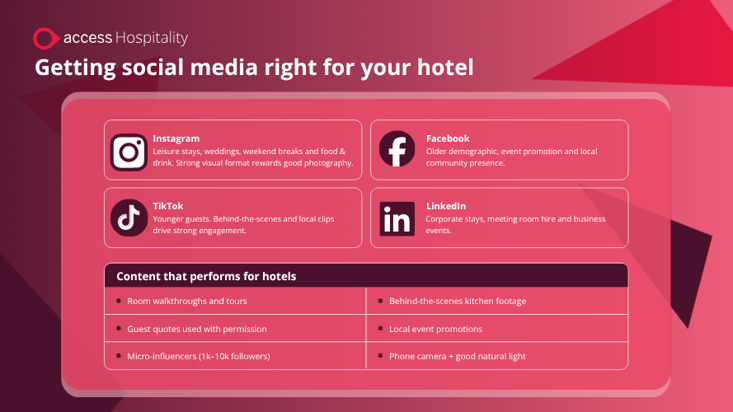
Not all social platforms will be right for your hotel so choose two and post consistently.
- Instagram is visual. Rooms, food and beverage, weddings and events work best on this platform.
- Facebook skews older and still does more than anything else for events, local reach and group business.
- TikTok reaches younger leisure travelers and rewards behind-the-scenes footage over polish. One caveat: the platform’s legal standing has been unsettled for years and isn’t fully resolved.
- LinkedIn earns its place if meetings, corporate rates and event space are part of your mix.
What actually performs
Room photography, behind-the-scenes clips, local event content and guest testimonials can outperform polished promotional posts for hotels on social media. Think about glimpses of your kitchen, pictures of your rooms, guest quotes used with permission and local event promotions.
Phocuswright research found that nearly two-thirds of travelers who used social media for trip planning made a purchase or visitation decision based on content they viewed, and micro-influencers with smaller, engaged followings can deliver authentic reach at low cost particularly for F&B content.
You just need a decent phone camera with good light to do the job, nothing fancy or high-tech.
Put digital marketing at the centre of how your hotel grows
A digital marketing plan for hotel operators doesn’t need to be expensive or complicated to fill more rooms. You need:
- A site that loads fast, shows the total price and describes your accessible rooms properly.
- A Google Business Profile that’s actually finished.
- Rates on metasearch, free booking links included.
- One pre-arrival email and one post-stay email that go out every time, without anyone remembering to send them.
- A social account that posts consistently.
More direct bookings, less OTA dependency and a stronger online presence are achievable without overhauling your operation. That’s what a hotel digital marketing strategy for the hotel industry amounts to at property level: a short list of things that work, done every time.
At Access Hospitality, we help you build marketing that works in the background, so your properties hold a strong online presence. We've helped our customers grow their direct business too. At Vista Investments' boutique properties, half of all reservations now come direct through the hotel websites.